
Quantitative Reasoning
1015SCG
Lecture 6
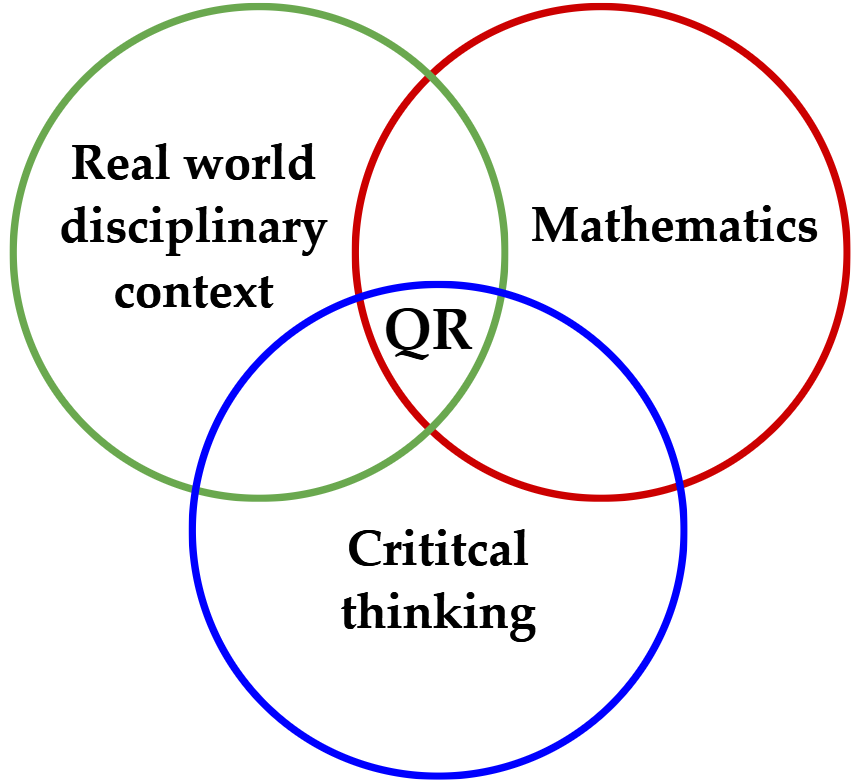
Critical thinking
Critical thinking
|
|
The Scientific Method...
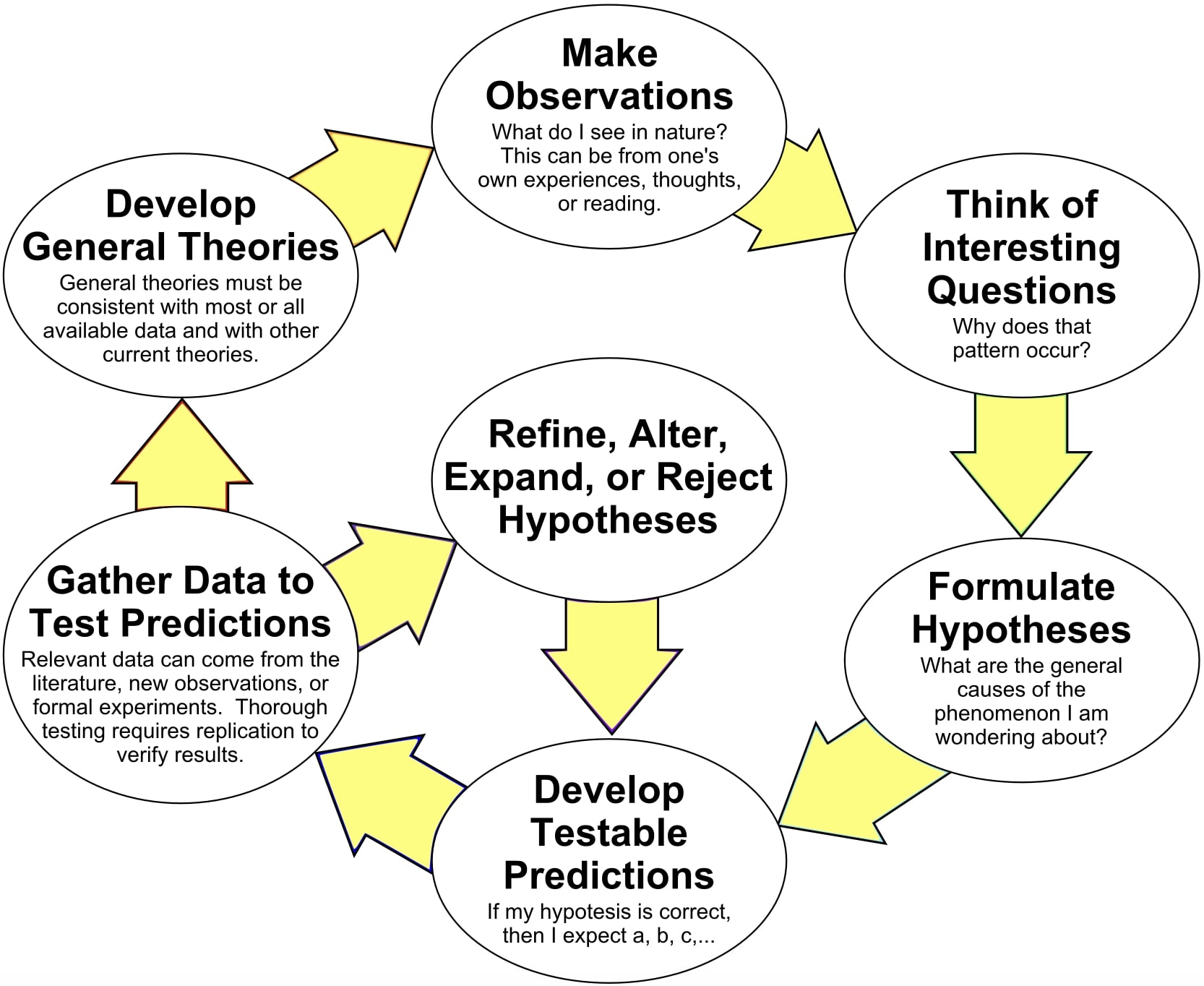
... is a human endeavour and mistakes happen.
Scientific Argumentation
- We should be able to defend our ideas and expect that others will do the same.
- The opponent challenges (argument) and the proponent defends (counter-argument).
- Avoid being aggressive, argumentative, or emotional.
- Separate the argument from the person making it.
- We easily miss our own mistakes.
- The goal is improvement and better results.
Critical Thinking Skills
|
Standards (qualities we value)
Components (pieces of the process)
|

|
Special elements of critical thinking
- Extraordinary claims require extraordinary evidence.
- Falsifiability.
- Recognizing fallacies and avoiding them.
- Balancing induction and deduction.
Problem Posing & Problem Solving
Problem posing
- Usual path in teaching maths:
Exposition → Examples → Exercises → Applications.
- Real life problems:
A quantitative question with no mathematical context, no data, and no direct means of answering.
Example 🐮
You got a farm, and you want to keep cattle on your farm. The barn you have is a rectangle 20 m by 25 m. The cows will be there to sleep or during bad weather. Otherwise, they have pasture. Which is the best estimate of the number of cows you can fit there?
- 5
- 50
- 500
- 5 000
👉 Area of barn $ = 20 \text{ m} \times 25 \text{ m}$ $= 500 \text{ m}^2$
Example 🐮
Area of barn $ = 500 \text{ m}^2.$ Estimate how many cows can sleep there.
- 5 →$\;\dfrac{500 \text{ m}^2}{5 \text{ cows}}$ $= 100{\text{ m}^2}/{ \text{ cow}}$
- 50 →$\;\dfrac{500 \text{ m}^2}{50 \text{ cows}}$ $= 10{\text{ m}^2}/{ \text{ cow}}$ ✅
- 500 →$\;\dfrac{500 \text{ m}^2}{500 \text{ cows}}$ $= 1{\text{ m}^2}/{ \text{ cow}}$
- 5 000 →$\;\dfrac{500 \text{ m}^2}{5000 \text{ cows}}$ $= 0.1{\text{ m}^2}/{ \text{ cow}}$
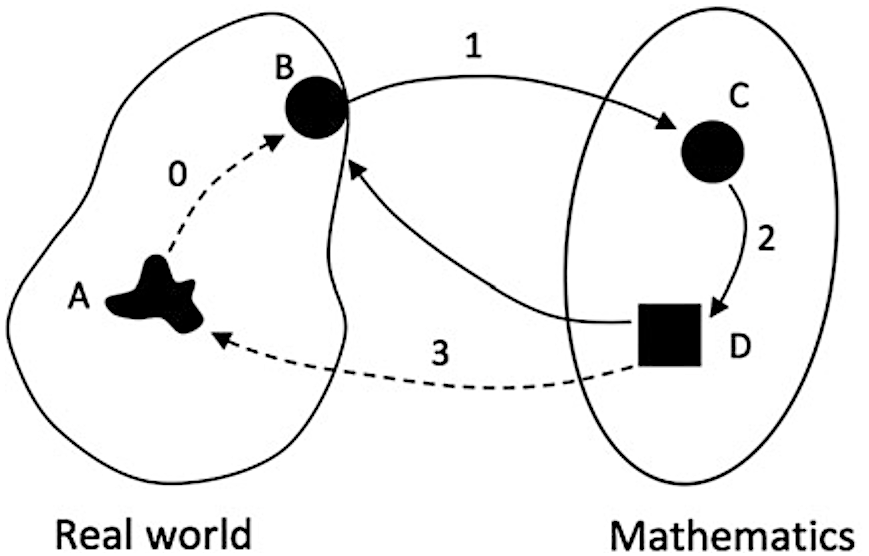
The cycle of mathematical problem posing & problem solving
|
A: Real situation
B: Real model
C: Math model
D: Math results |
|
Blum, W., & Kirsch, A. (1989). The problem of the graphic artist. In W. Blum, J. S. Berry, R. Biehler, I. D. Huntley, G. Kaiser-Meßmer, & L. Profke (Eds.), Applications and modelling in learning and teaching mathematics (pp. 129-135). Chichester: Ellis Horwood.
Recall example about the barn with cows 🐮
A. Real situation: barn with cows.
B. Real model: dimensions, purpose, possible numbers.
C. Math model: compute barn area, estimate space per cow.
D. Math results: area per cow and number of cows per m².
→ Return to real situation to choose a reasonable answer.
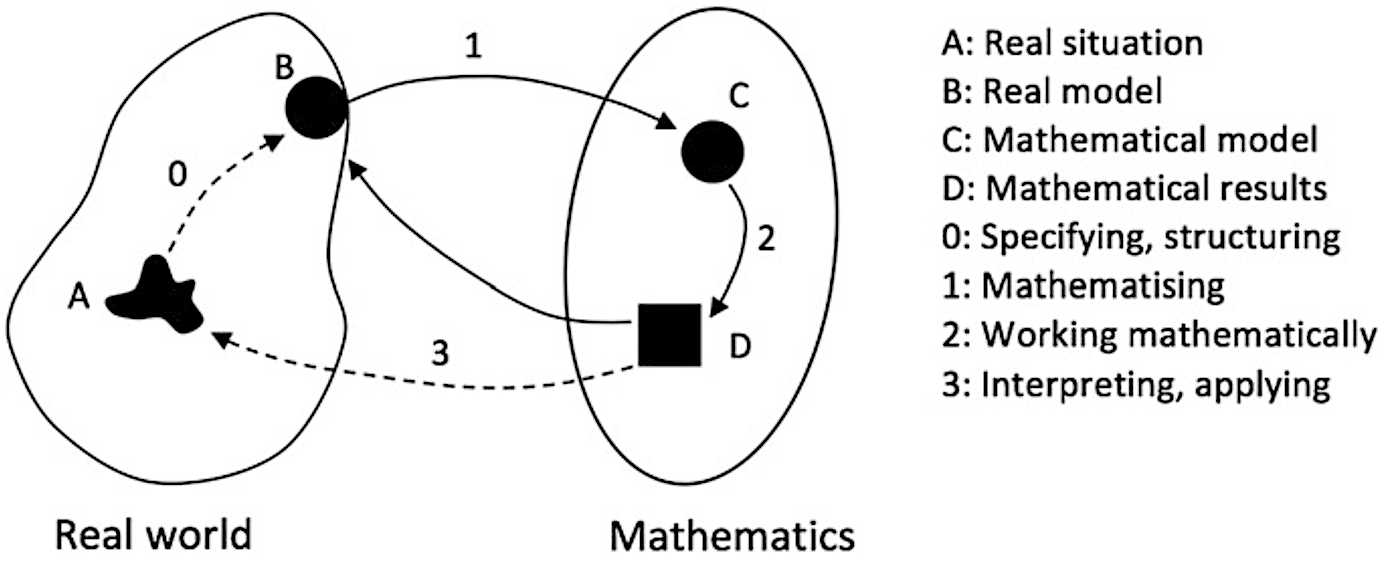
Mathematical problem posing & problem solving
Useful skills:
- Mathematical content.
- Heuristics / strategies / rules of thumb.
- Meta-cognition:
- What are you doing?
- Why are you doing it?
- How will it help?
- Beliefs and attitudes.
🧩 Mathematical Problem Solving
Polya's four step problem solving method:
- Understand the problem
- Devise a plan
- Carry out the plan
- Reflect
Source: How To Solve It, by George Polya, 2nd ed., Princeton University Press, 1957.
🧩 Mathematical Problem Solving
Step 1: Understand the problem.
- Do you understand all words?
- Can you restate it?
- What are you asked to find?
- Would a diagram help?
- Is the given information enough?
🧩 Mathematical Problem Solving
Step 2: Devise a plan (often hardest).
- Relate to similar problems.
- Use examples.
- Simplify or modify.
- Break into smaller parts.
- Work backwards.
- Use known strategies.
🧩 Mathematical Problem Solving
Step 3: Carry out the plan.
- Be patient.
- Pay attention to details.
- Don't give up too quickly.
- Revise if the plan fails.
🧩 Mathematical Problem Solving
Step 4: Reflect.
- Can you check the answer?
- Could you solve it differently?
- Does the result tell you something interesting?
- What other problems could be solved with this method?
📝 Practice 😃
☕️ Caffeine
|
How many 1L bottles can I drink per day? Recommendation: less than 400 mg caffeine per day. |
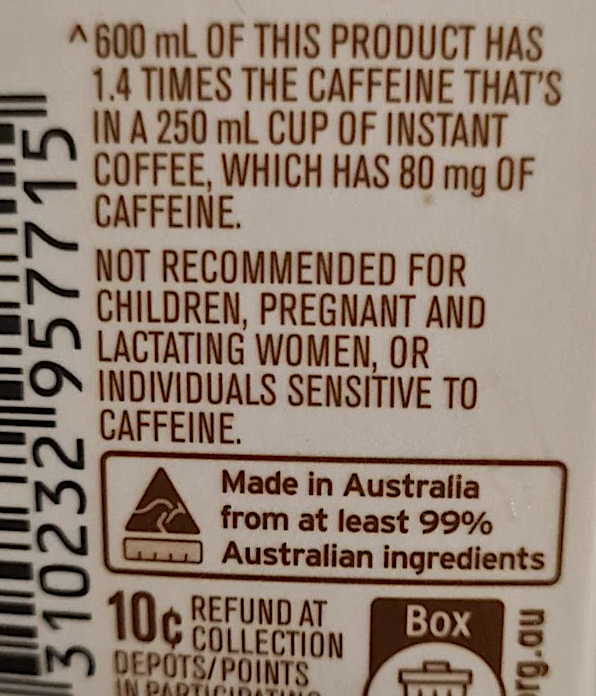
|
☕️ Caffeine
|
1. Understand the problem
|
|
☕️ Caffeine
|
2. Devise a plan
|
|
☕️ Caffeine
|
3. Carry out the plan
|
|
☕️ Caffeine
|
4. Reflect
|
|
🍕 Pizza party
I want to host a party with 10 people coming. Each person will eat 2/3 of a pizza. My local pizza place has a deal with 2 pizzas for $12. How much will I spend on pizza?

🍕 Pizza Party
1. Understand the Problem
- 10 people are coming.
- Each person eats \( \dfrac{2}{3} \) of a pizza.
- Pizzas come in a 2-for-$12 deal.
- We will round the total pizza needed up to the nearest even number to use the deal.
🍕 Pizza Party
2. Devise a Plan
- Compute total pizza needed: \(10 \text{ person} \times \dfrac{2}{3} \dfrac{\text{pizza}}{\text{person}}.\qquad \qquad\)
- Round this number up to the nearest even integer.
- Calculate total cost using the deal (2 pizzas for $12).
🍕 Pizza Party
3. Carry Out the Plan
- Total pizza needed:
\(10 \text{ person} \times \dfrac{2}{3} \dfrac{\text{pizza}}{\text{person}}\) \( = \dfrac{20}{3} \text{ pizzas}\) \(\approx 6.6 \text{ pizzas}\qquad \qquad\)
- Rounded up to the nearest even number → 8 pizzas.
- A deal = 2 pizzas for $\$12$ (that is, 6 dollars per pizza).
- Total cost: \(6\dfrac{\text{dollars}}{\text{pizza}} \times 8 \text{ pizzas} = \$48\).
🍕 Pizza Party
4. Reflect
- Rounding up ensures we buy enough pizza for everyone.
- 8 pizzas fully uses the 2-for-$12 deal.
- Total cost for the party: $48.
- You will have extra pizza (good for guests!). 🍕

🥤 Cans and Bottles
I can get 10c for each can and bottle I recycle. But the nearest recycling point is 85 km away. My car burns 6L of gas per 100 km, and the gas costs $2 per liter. How many cans and bottles do I need for the trip to pay for itself? What will be the volume of the cans and bottles? How much money can I make?
Assume each container (can and bottle) holds \(0.5\) L.
🥤 Cans and Bottles
1. Understand the Problem
- Distance to recycling point: 85 km (one way).
- Round trip distance: \(170\) km.
- Fuel consumption: \(6 \text{ L per 100 km}\).
- Fuel price: \($2\) per liter.
- Refund: \($0.10\) per container.
- Assume each container (can and bottle) holds \(0.5\) L.
🥤 Cans and Bottles
2. Devise a Plan
- Calculate total fuel used for 170 km.
- Calculate total fuel cost.
- Divide fuel cost by $0.10 to find required number of containers.
- Multiply number of containers by 0.5 L to find total volume.
- Check profit for larger amounts.
🥤 Cans and Bottles
3. Carry Out the Plan
- Fuel used: \(170 \text{ km} \times \dfrac{6 \text{ L}}{100 \text{ km}} = 10.2 \text{ L}\)
- Fuel cost: \(10.2 \text{ L} \times 2 \dfrac{\text{dollars}}{\text{L}} = 20.4 \text{ dollars}\)
- Containers needed to break even: \(\dfrac{20.4}{0.10} = 204 \text{ containers}\)
- Total volume: \(204 \times 0.5 \text{ L} = 102 \text{ L}\)
🥤 Cans and Bottles
4. Reflect
- You need at least 204 containers to cover fuel costs.
- That corresponds to 102 litres of containers.
- If you collect more than 204 containers, you start making profit.
-
Example:
300 containers → $\$30$ refund − $\$20.4$ fuel = $9.6 profit. - This shows how transport costs strongly affect small recycling profits.
📝 Extra practice 😃
🚗 Car vs 🚊 tram
Should I drive to Uni or take the tram?
🍜 Lunch
You would like to have more balanced meals for lunch but you don't have time for meal prepping. You consider buying microwave meals to bring it to the campus. You have two options - one a healthy brand or a supermarket brand. Which option is better?
🤔 Puzzle: A bear leaves point P, walks one mile south, then one mile east, and finally one mile north, returning exactly to point P. What color is the bear?
That's all for today!
See you in Week 7!