
Foundation Mathematics
1017SCG
Lecture 3
Topics for Week 3
- Radians
- Special Triangles
- Unit Circle
- Like and Unlike terms (Algebra)
Radians
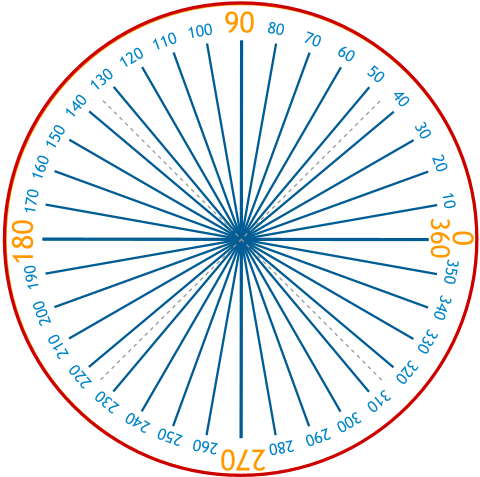
Radians
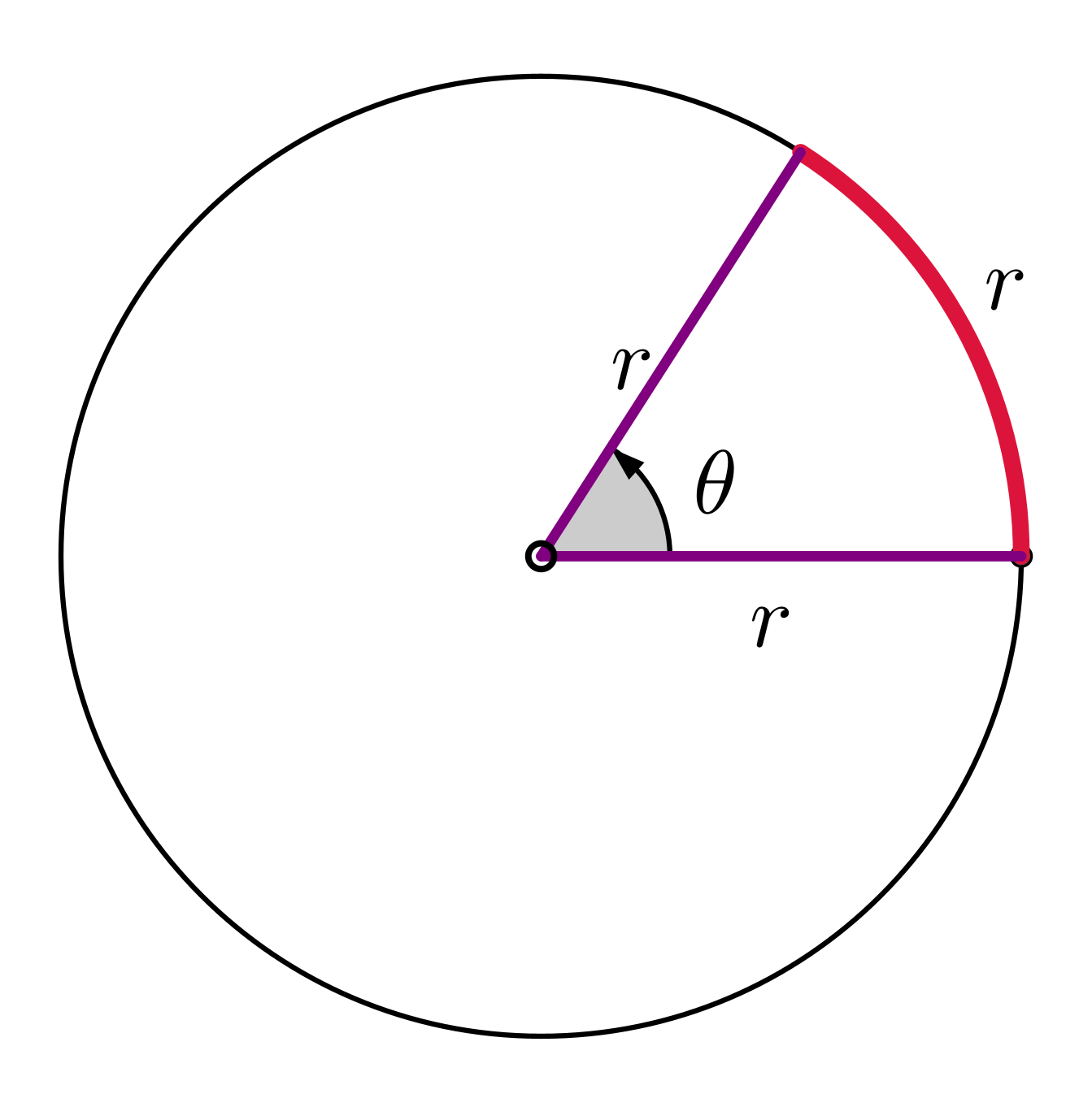
Radians
|
\(\theta = \dfrac{\text{Arc length}}{\text{Radius}}\) \(\theta = \dfrac{ r}{r }\) \(=1\,\text{radian}\) |
Radians
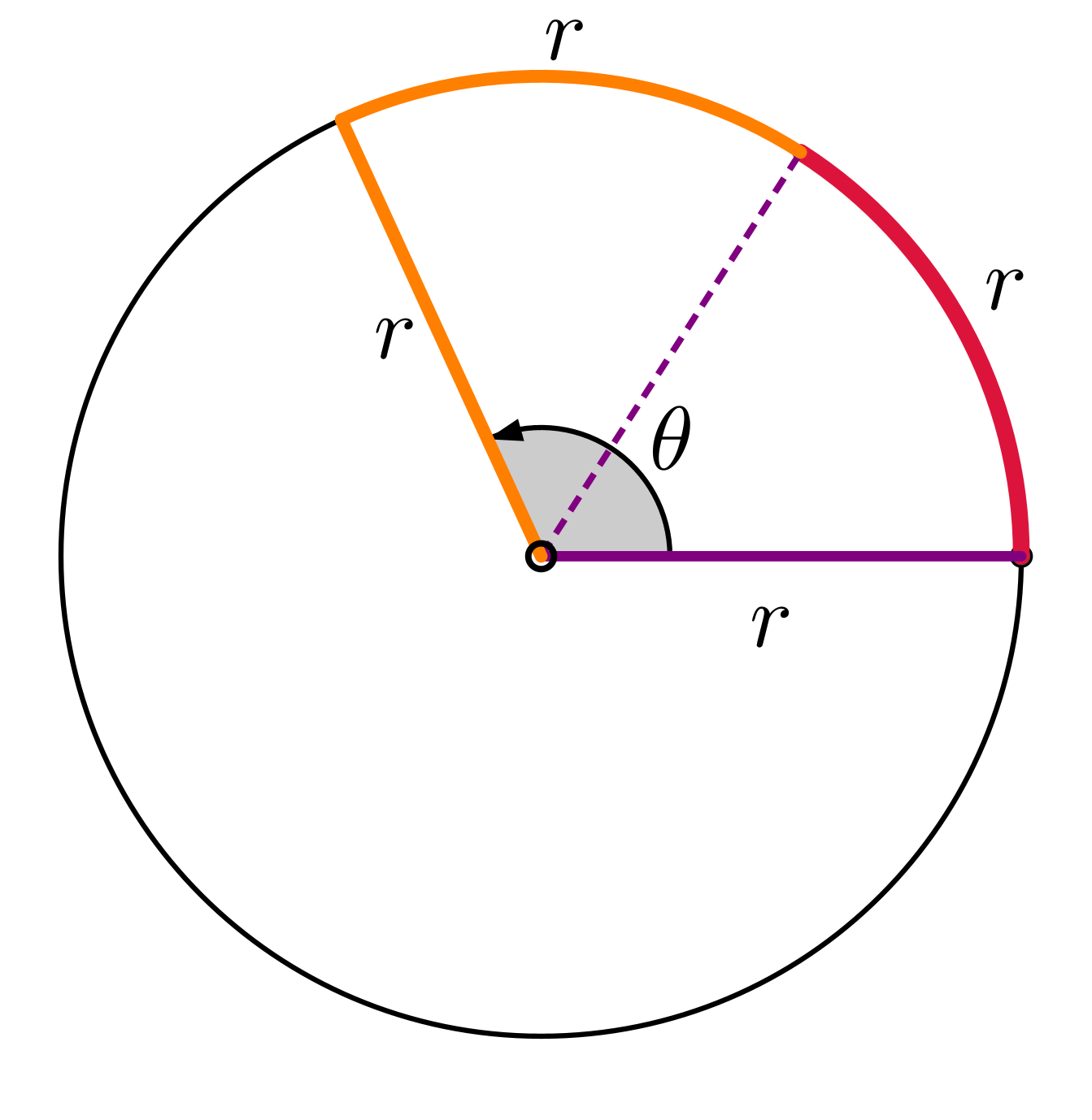
|
\(\theta = \dfrac{\text{Arc length}}{\text{Radius}}\) \(\theta = \dfrac{2 r}{r }\) \(\;\;\; =2\,\text{radians}\) |
Radians
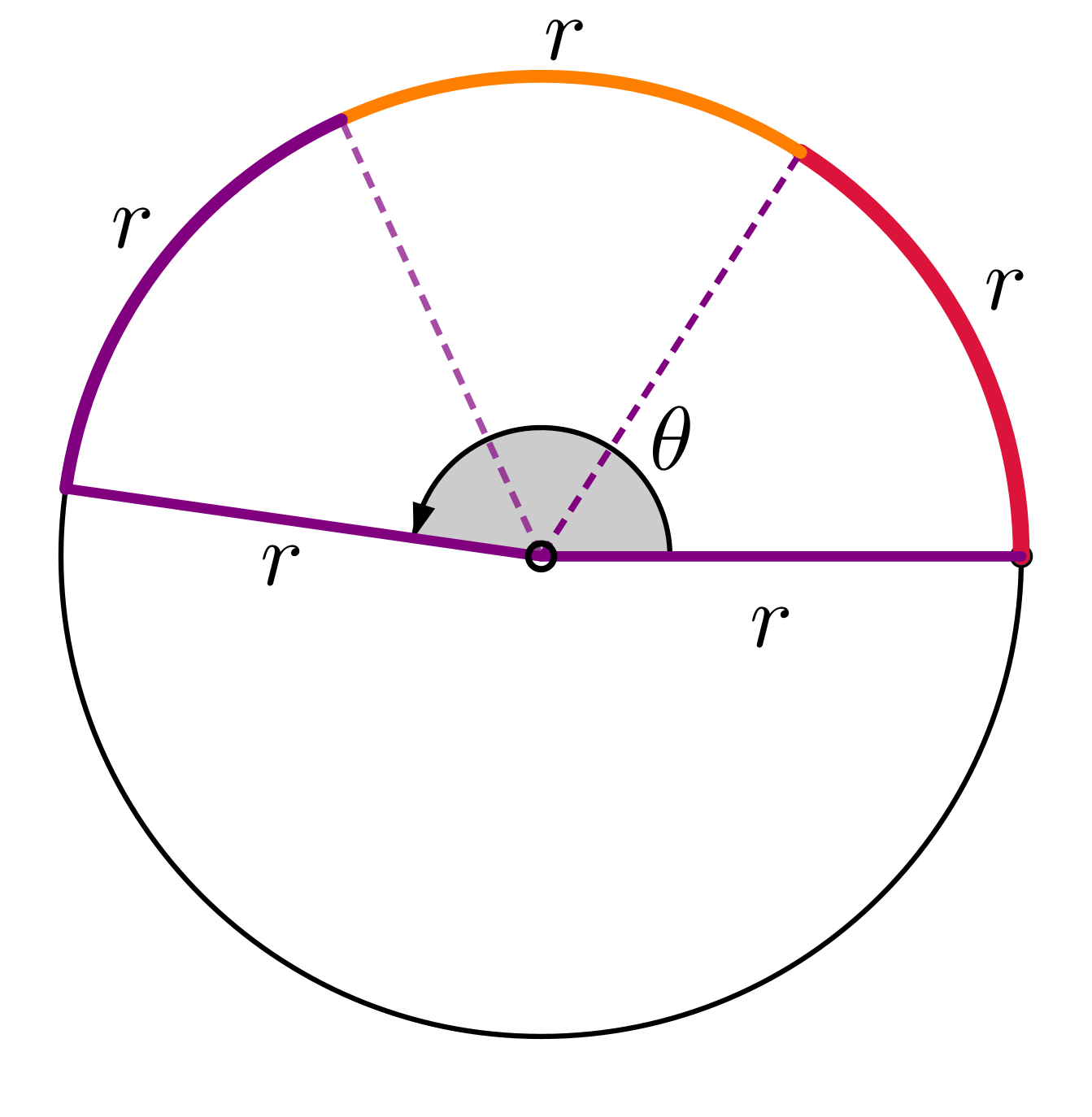
|
\(\theta = \dfrac{\text{Arc length}}{\text{Radius}}\) \(\theta = \dfrac{3 r}{r }\) \(\;\;\; =3\,\text{radians}\) |
Radians
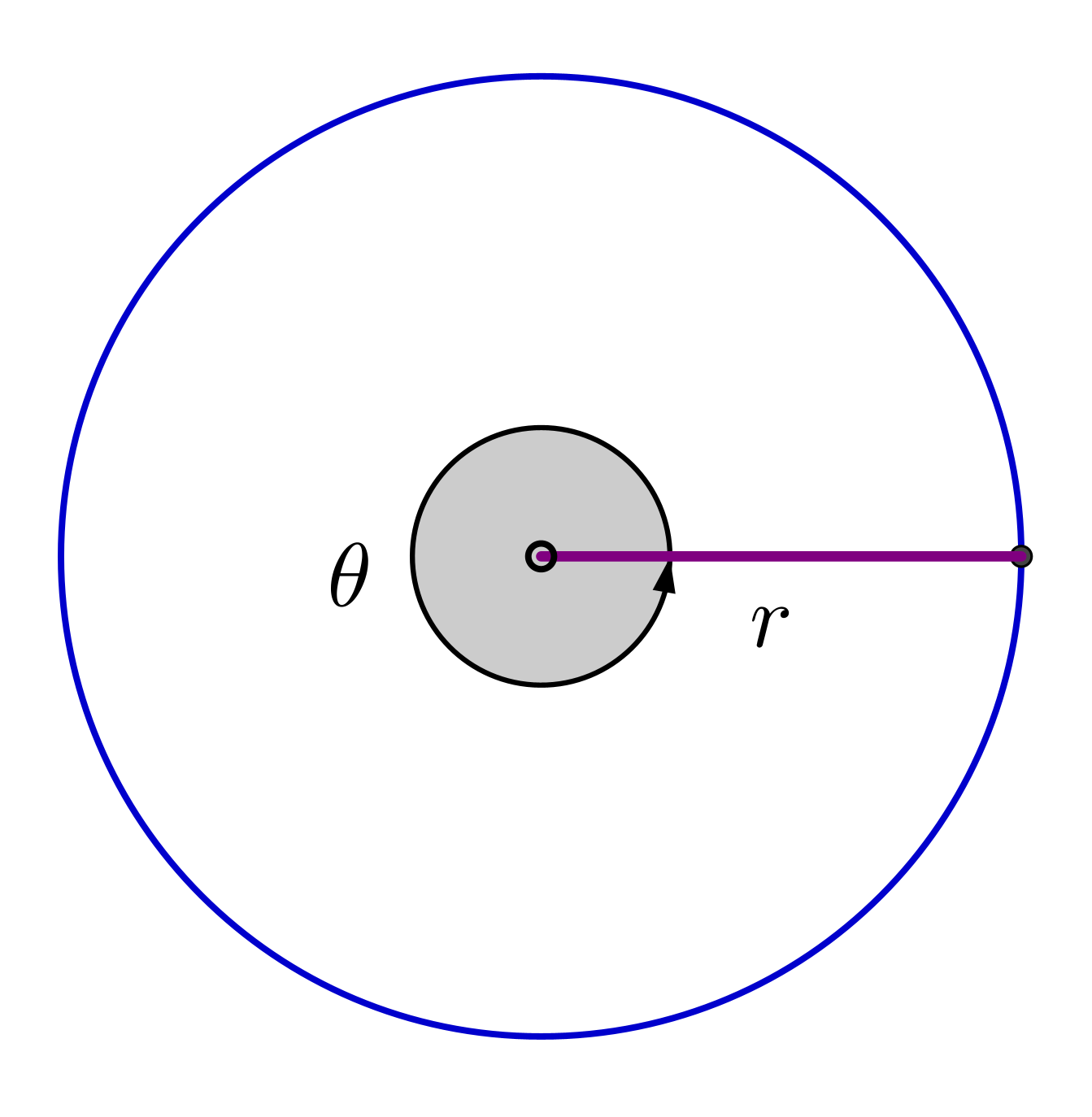
|
\(\theta = \dfrac{\text{Arc length}}{\text{Radius}}\) \(\theta = \dfrac{2\pi r}{r }\) \(\;\;\; =2\pi\,\text{radians}\) |
Radians

By Lucas Vieira
Radians
Two different measurements of an angle:
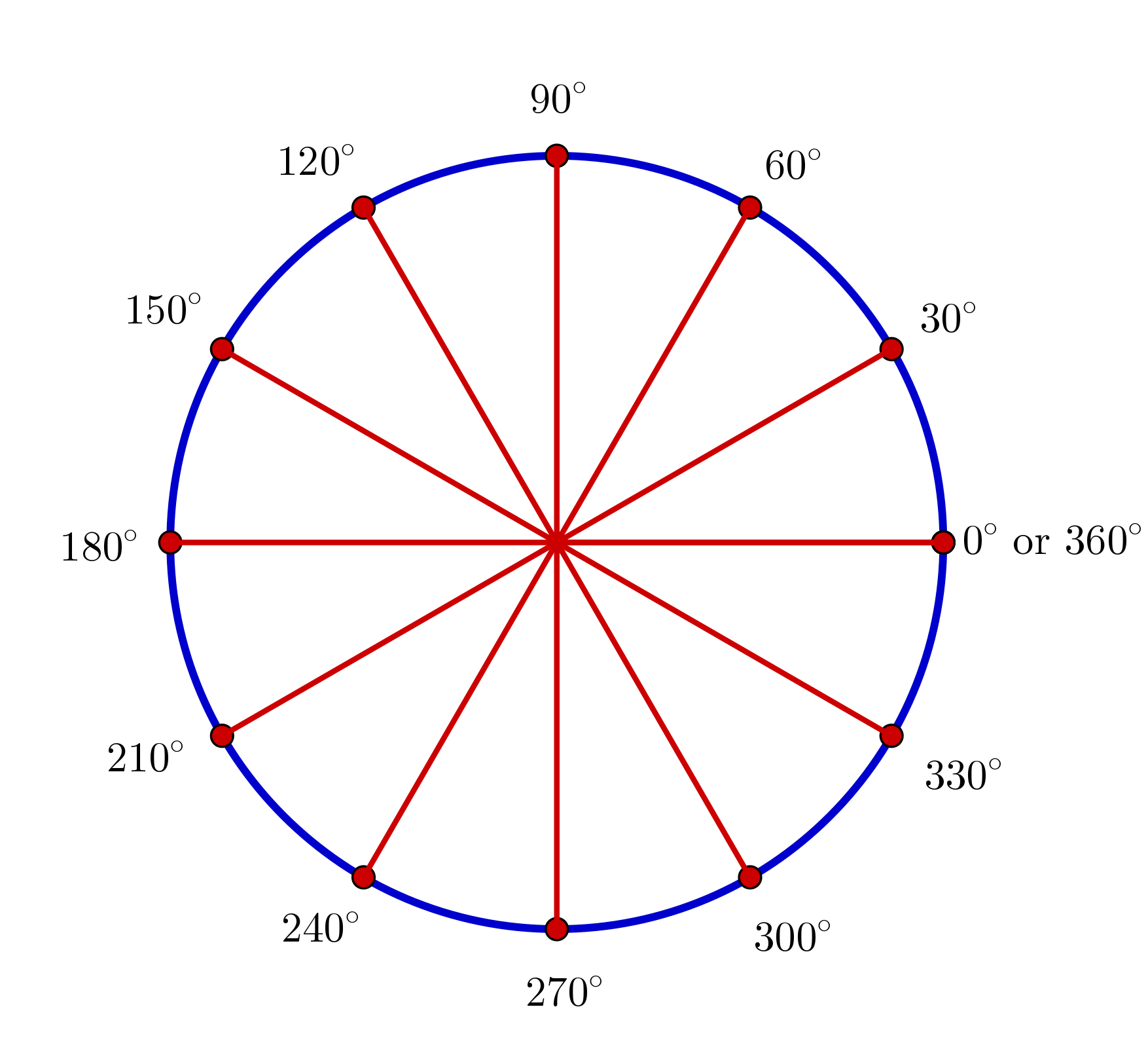
Degrees |
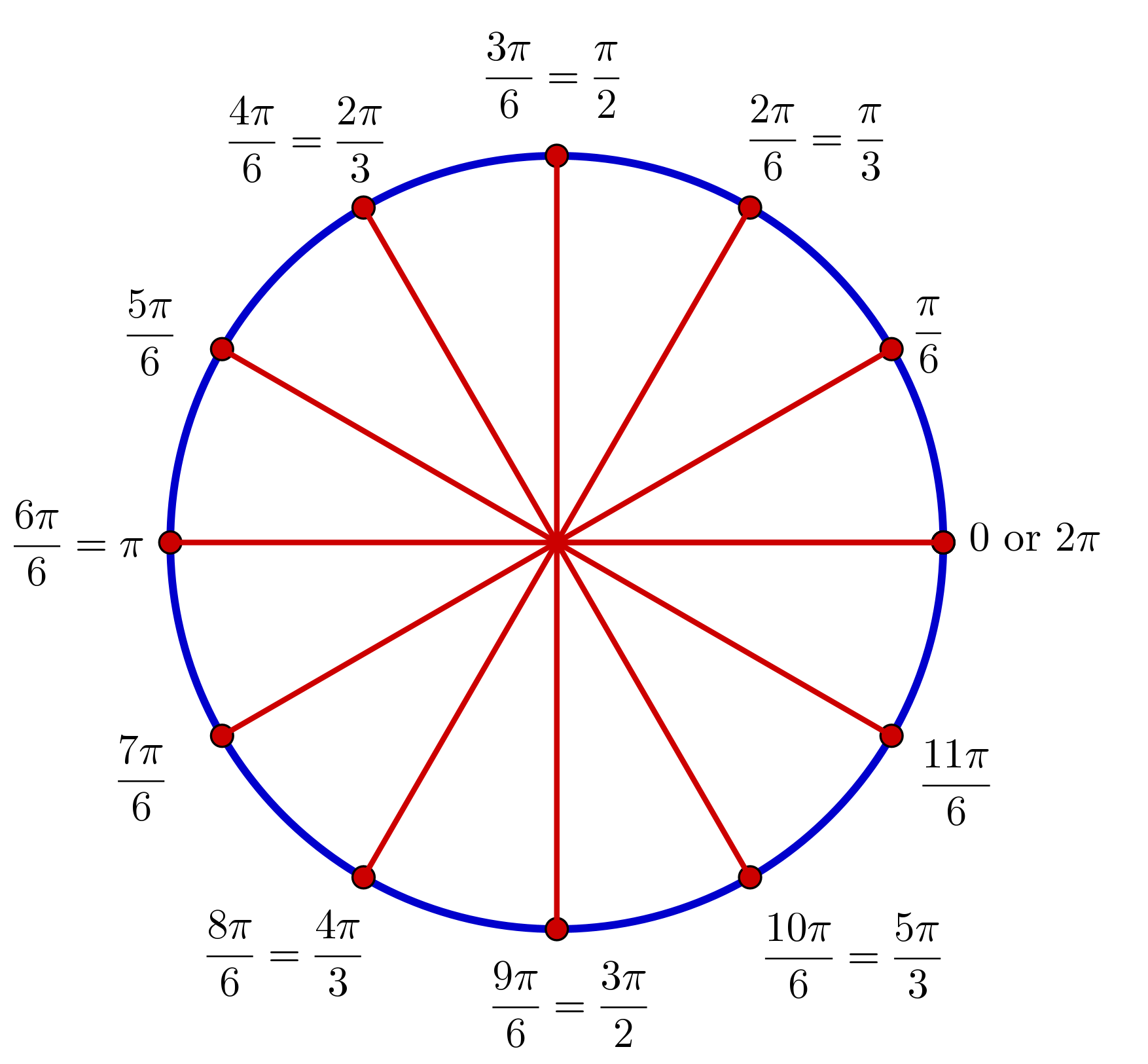
Radians |
How do we convert degrees to radians and vice versa?

How do we convert degrees to radians and vice versa?
\(\large 360^{\circ} = 2\pi \,\text{radians}\)
\(\large \dfrac{360^{\circ}}{360} = \dfrac{2\pi}{360} \,\text{radians}\)
\(\large 1^{\circ} =\dfrac{\pi}{180} \,\text{radians}\)
Degrees to Radians
How do we convert degrees to radians and vice versa?
\(\large 2\pi \,\text{radians} = 360^{\circ} \)
\(\large \dfrac{2\pi }{2\pi}\,\text{radians} = \dfrac{360^{\circ} }{2\pi} \)
\(\large 1 \,\text{radian} =\dfrac{180^{\circ}}{\pi} \)
\(\large 1 \,\text{radian} =\dfrac{180}{\pi}\, \text{degrees} \)
Radians to Degrees
How do we convert degrees to radians and vice versa?
Degrees to Radians:
\[ \begin{eqnarray*} \large 1^{\circ} =\dfrac{\pi}{180} \,\text{radians} \end{eqnarray*} \]
Radians to Degrees:
\[ \begin{eqnarray*} \large 1\, \text{radian} = \dfrac{180}{\pi}\,\text{degrees} \end{eqnarray*} \]
How do we convert degrees to radians and vice versa?
Example 1 (Degree to radian): \( \; 30^{\circ} \;\)
\( 30^{\circ} \times \dfrac{\pi}{180} \) \( = \dfrac{30\pi}{180} \)
\(\qquad \quad\;\; =\dfrac{3\pi}{18}\)
\( \qquad \qquad\qquad =\dfrac{\pi}{6} \,\text{radians}\)
Therefore \( \,30^{\circ} = \dfrac{\pi}{6} \,\text{radians}\)
How do we convert degrees to radians and vice versa?
Example 2 (Degree to radian):\( \; 45^{\circ} \)
\( 45^{\circ} \times \dfrac{\pi}{180} \) \( = \dfrac{45\pi}{180} \;\;\)
\( \qquad\qquad \quad\; =\dfrac{\pi}{4} \,\text{radians}\)
Therefore \( \,45^{\circ} = \dfrac{\pi}{4} \,\text{radians}\)
How do we convert degrees to radians and vice versa?
Example 3 (Degree to radian): \( \; 60^{\circ} \)
\(60^{\circ} \times \dfrac{\pi}{180} \) \( = \dfrac{60\pi}{180}\)
\( \qquad\qquad \qquad =\dfrac{\pi}{3} \,\text{radians}\)
Therefore \( \,60^{\circ} = \dfrac{\pi}{3} \,\text{radians}\)
How do we convert degrees to radians and vice versa?
Example 4 (Radian to degree): \(\; \dfrac{2\pi}{3} \)
\( \dfrac{2\pi}{3} \times \dfrac{180}{\pi} \) \( = \dfrac{360}{3} \;\;\)
\(\qquad \qquad =120^{\circ}\;\)
Therefore \( \,\dfrac{2\pi}{3} \,\text{radians} = 120^{\circ} \)
How do we convert degrees to radians and vice versa?
Example 5 (Radian to degree):\(\; \dfrac{3\pi}{4} \)
\( \dfrac{3\pi}{4} \times \dfrac{180}{\pi} \) \( = \dfrac{540}{4}\)
\(\qquad \qquad\; =135^{\circ}\;\)
Therefore \( \,\dfrac{3\pi}{4} \,\text{radians} = 135^{\circ} \)
Common notation
| Degrees | Radians |
|
|
Special Triangles
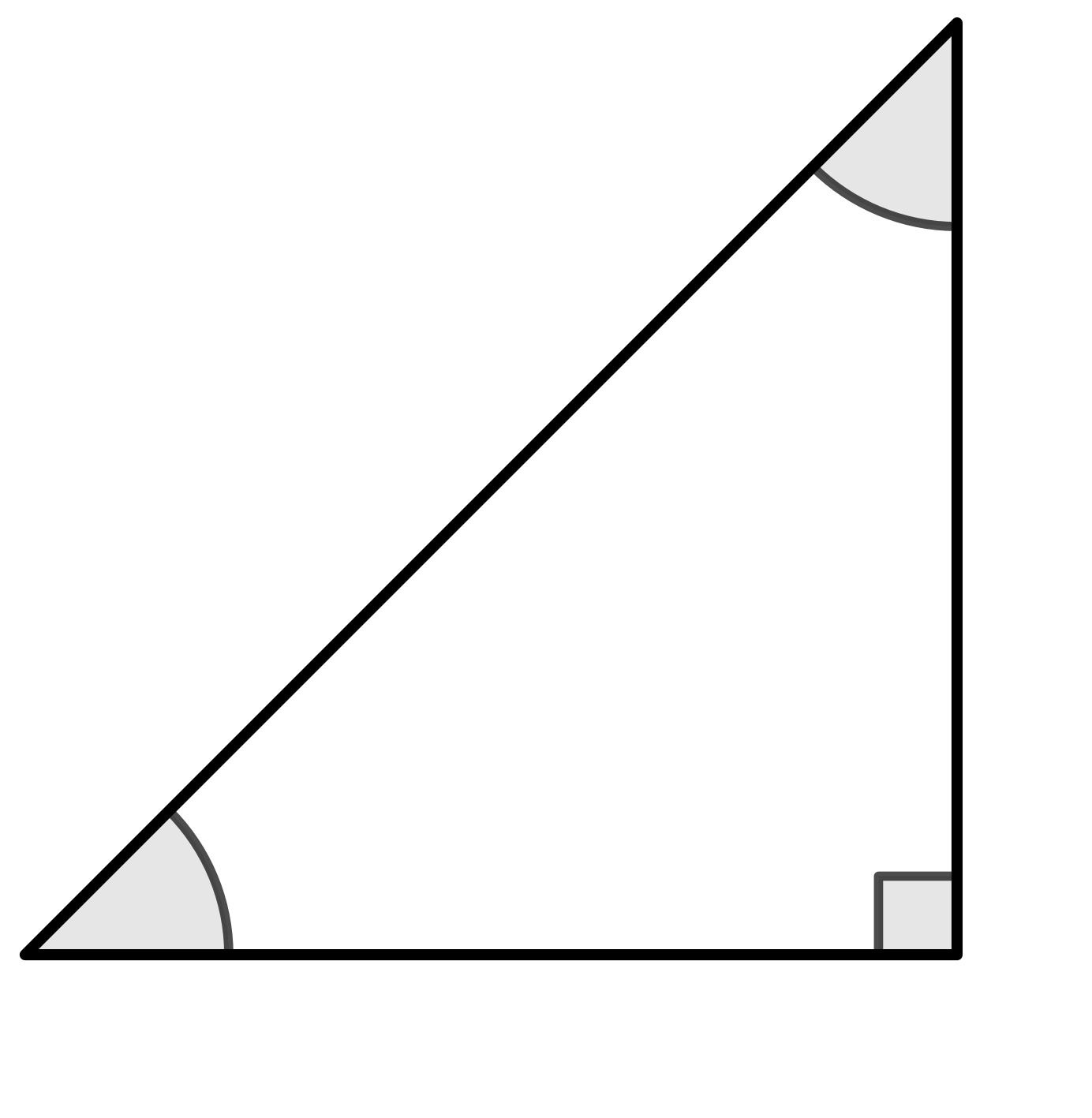
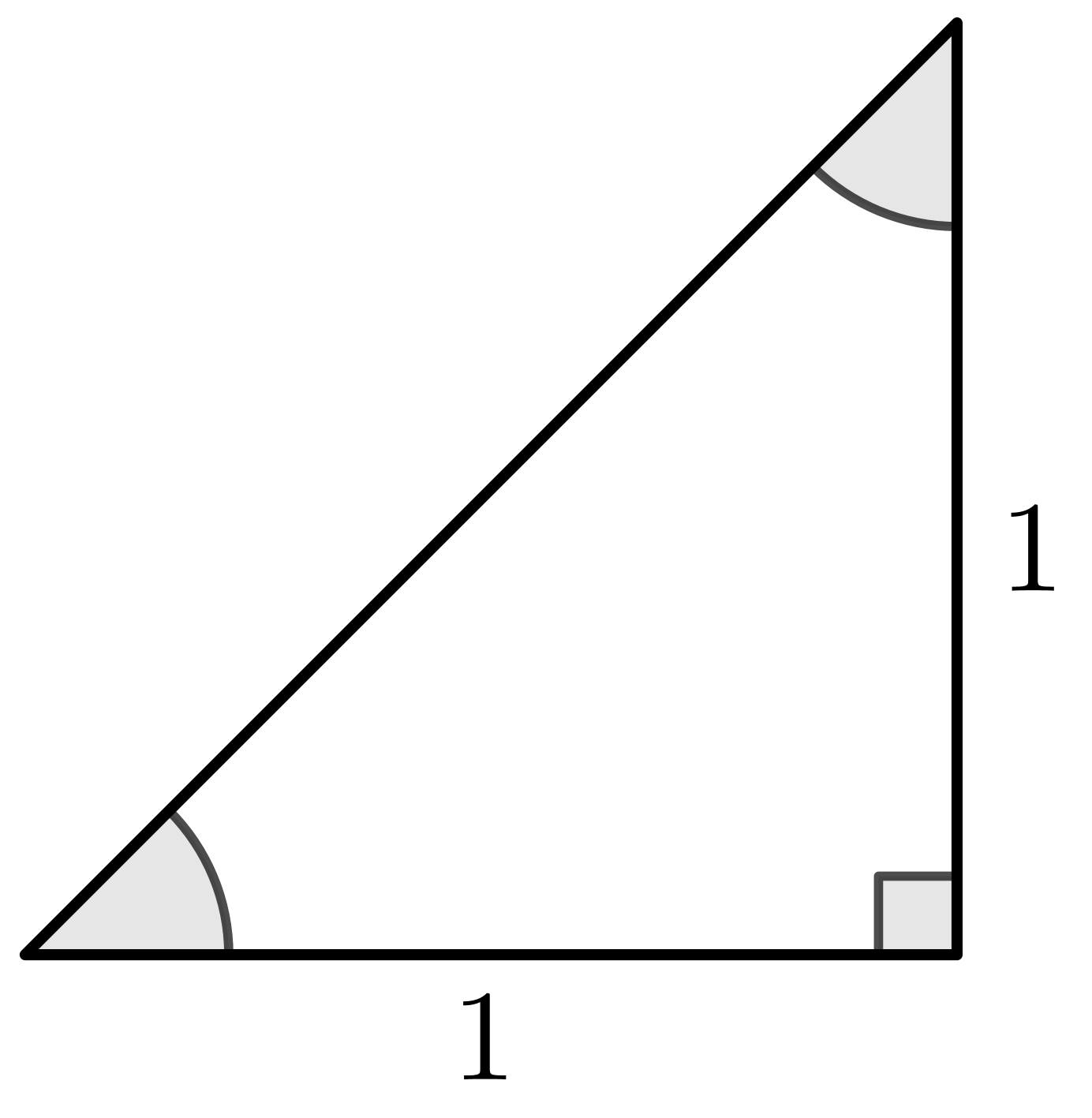
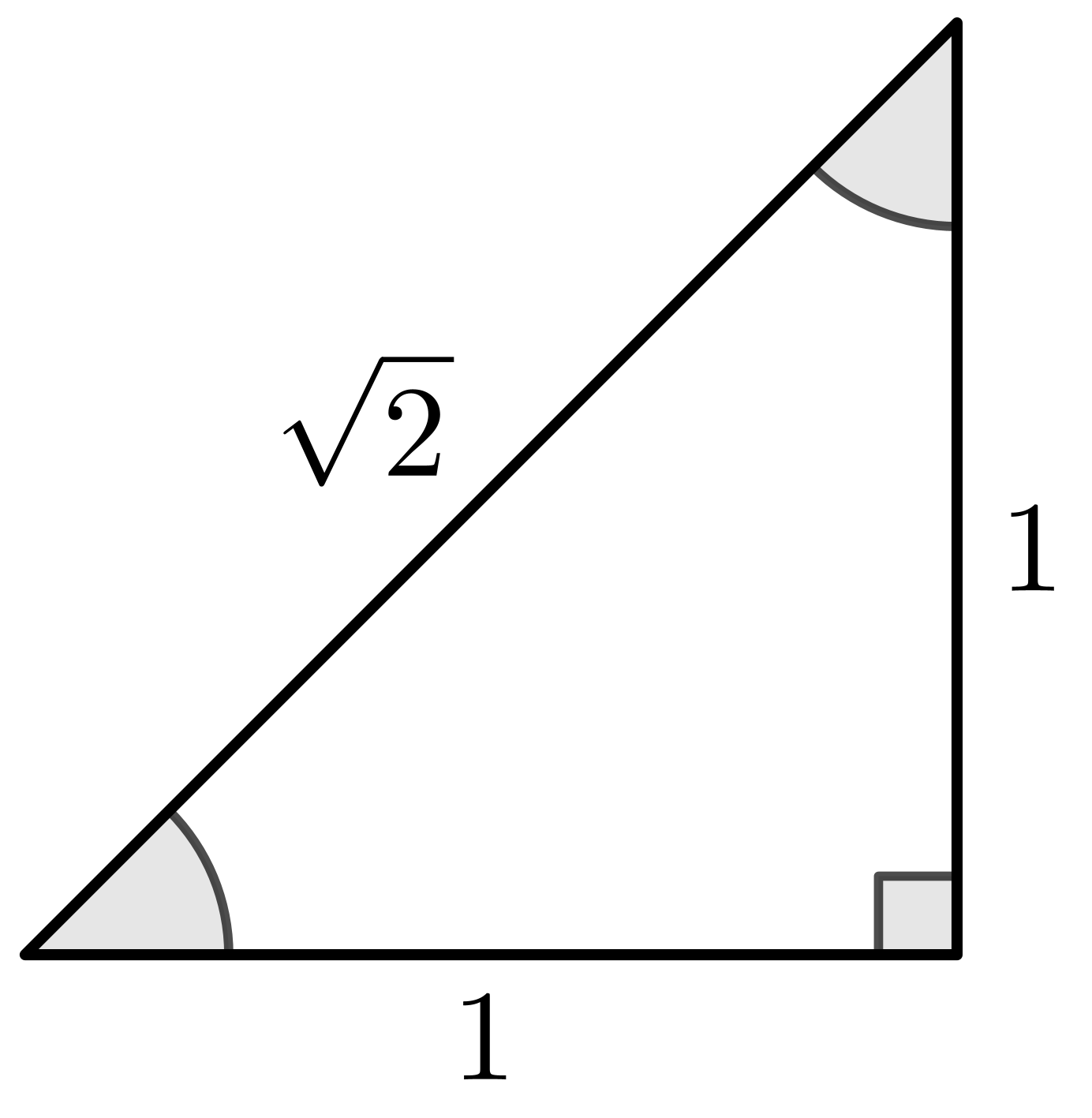
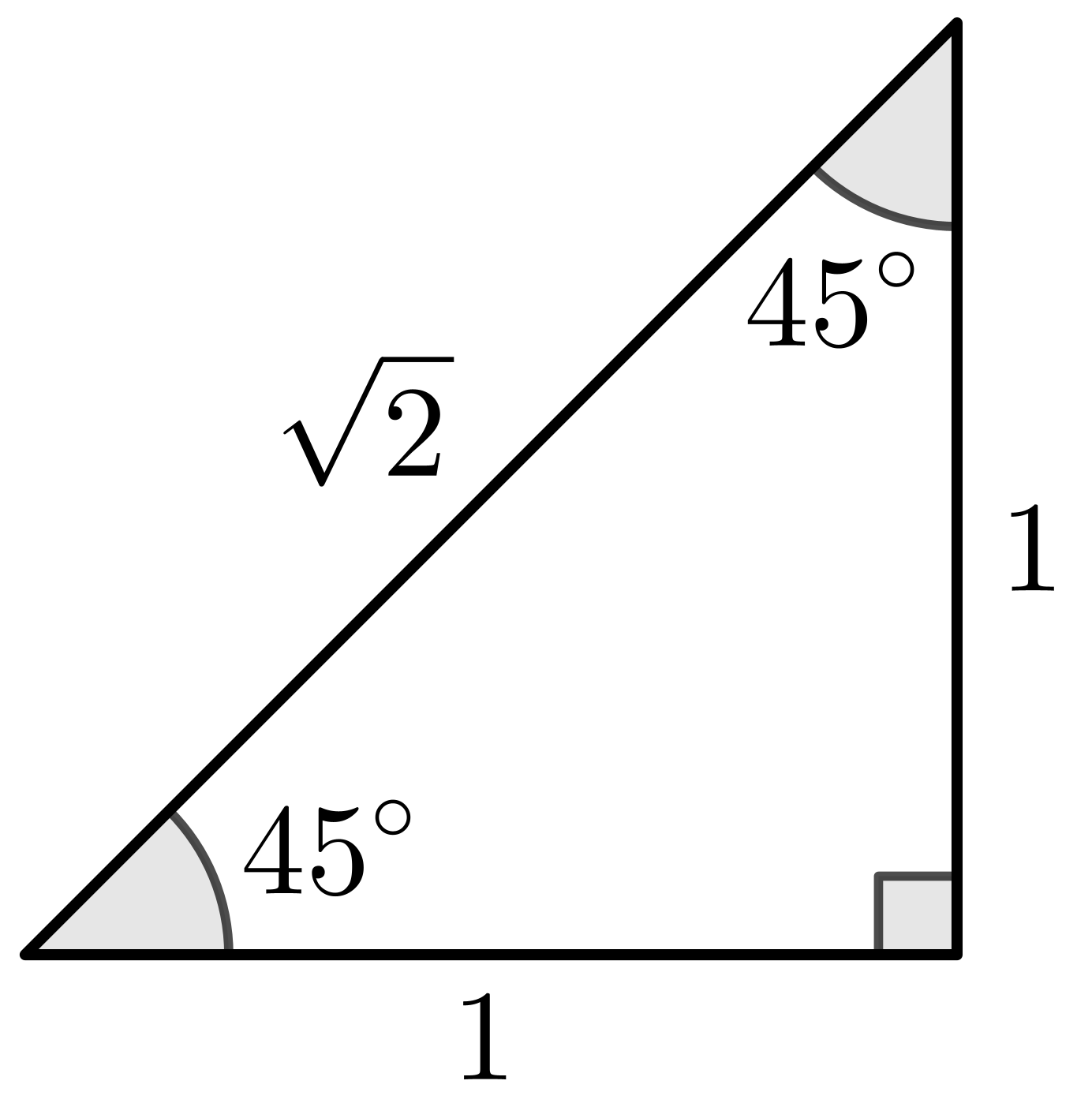
Special Triangles
|
|
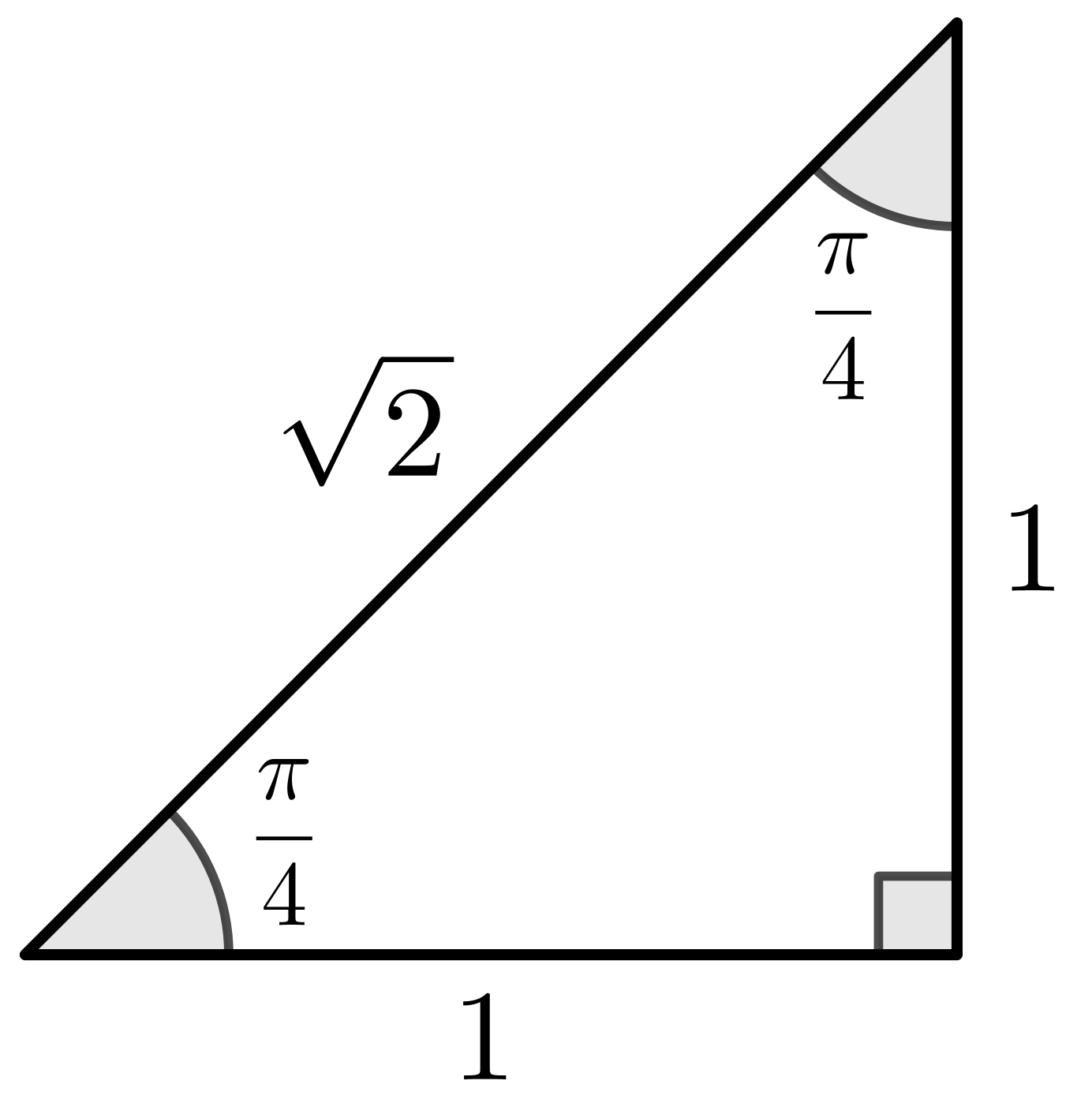
|
Special Triangles
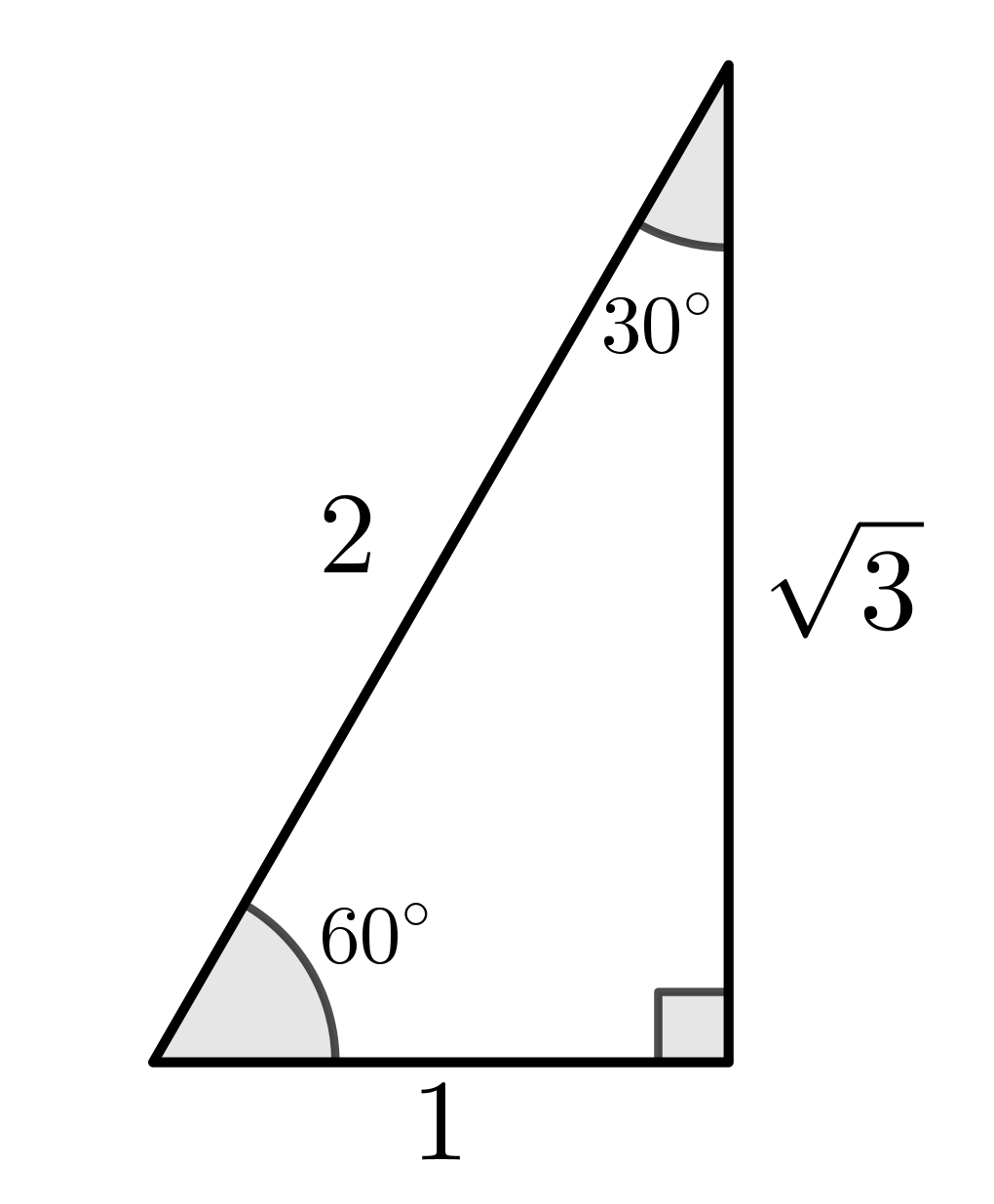
|
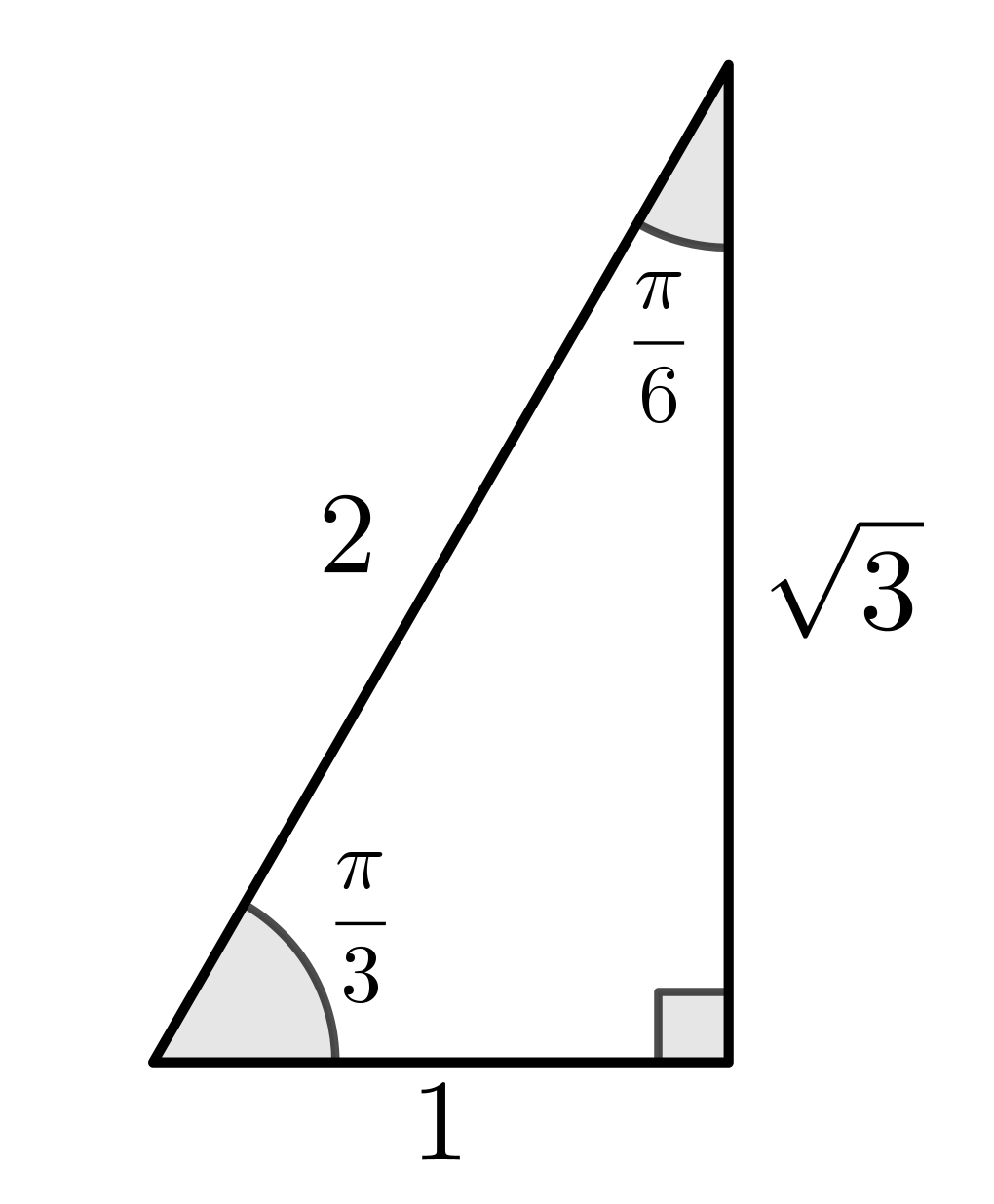
|
Special Triangles
|
|
|
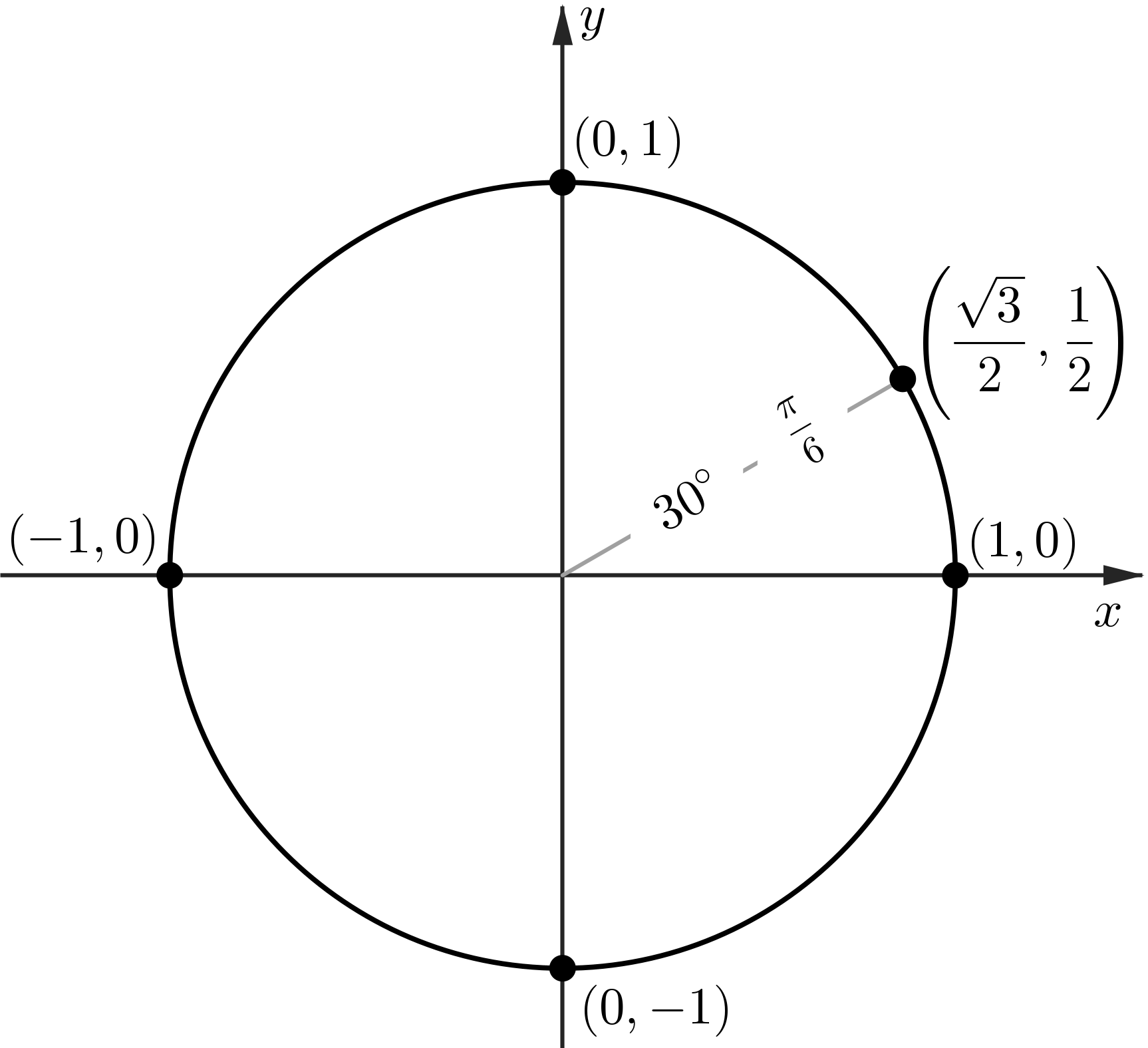
\(\sin \left(30^{\circ }\right)\) \(=\dfrac{1}{2}\) \(\cos \left(30^{\circ }\right)\) \(=\dfrac{\sqrt{3}}{2}\) \(\tan \left(30^{\circ }\right)\) \(=\dfrac{1}{\sqrt{3}}\) |
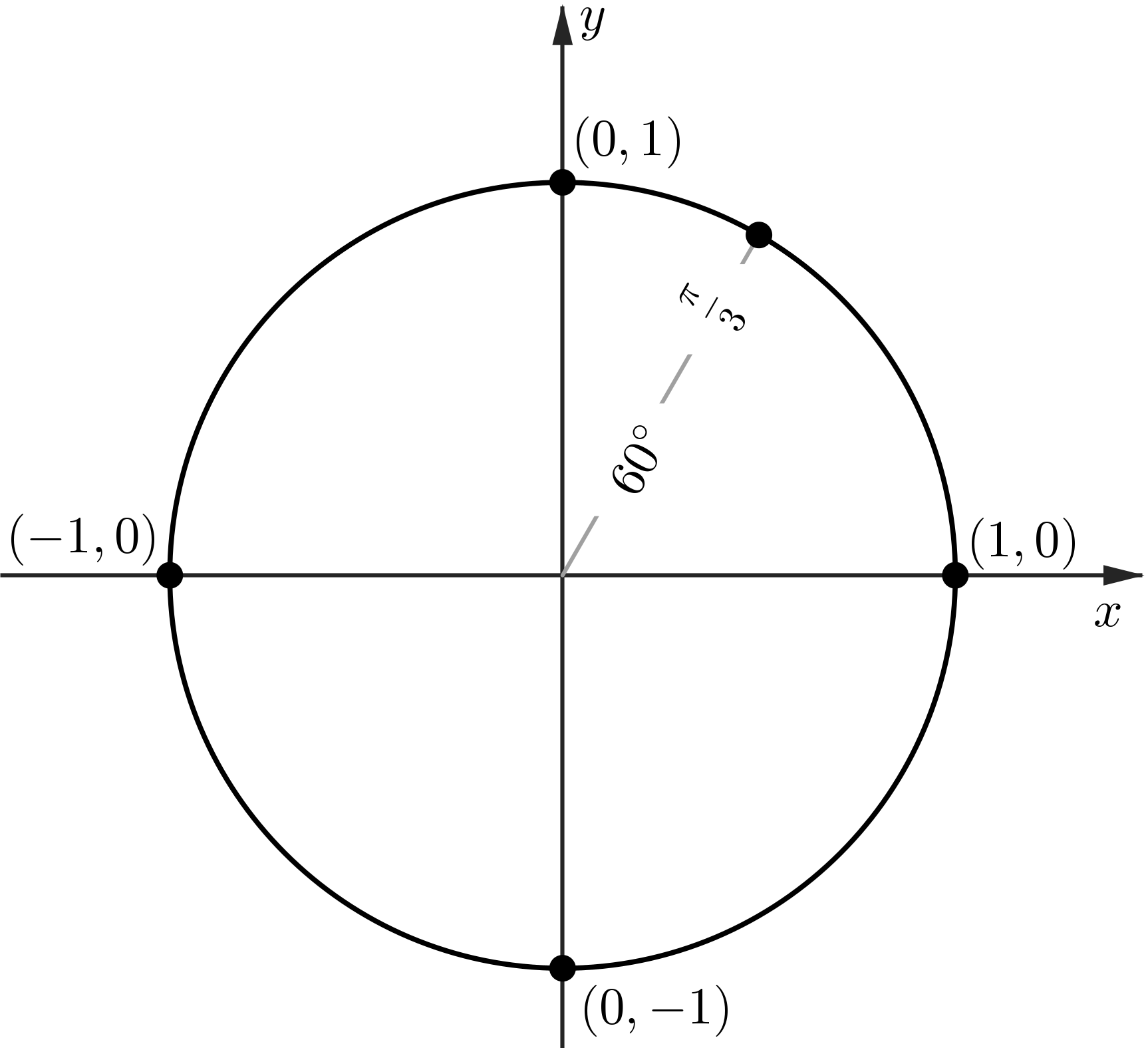
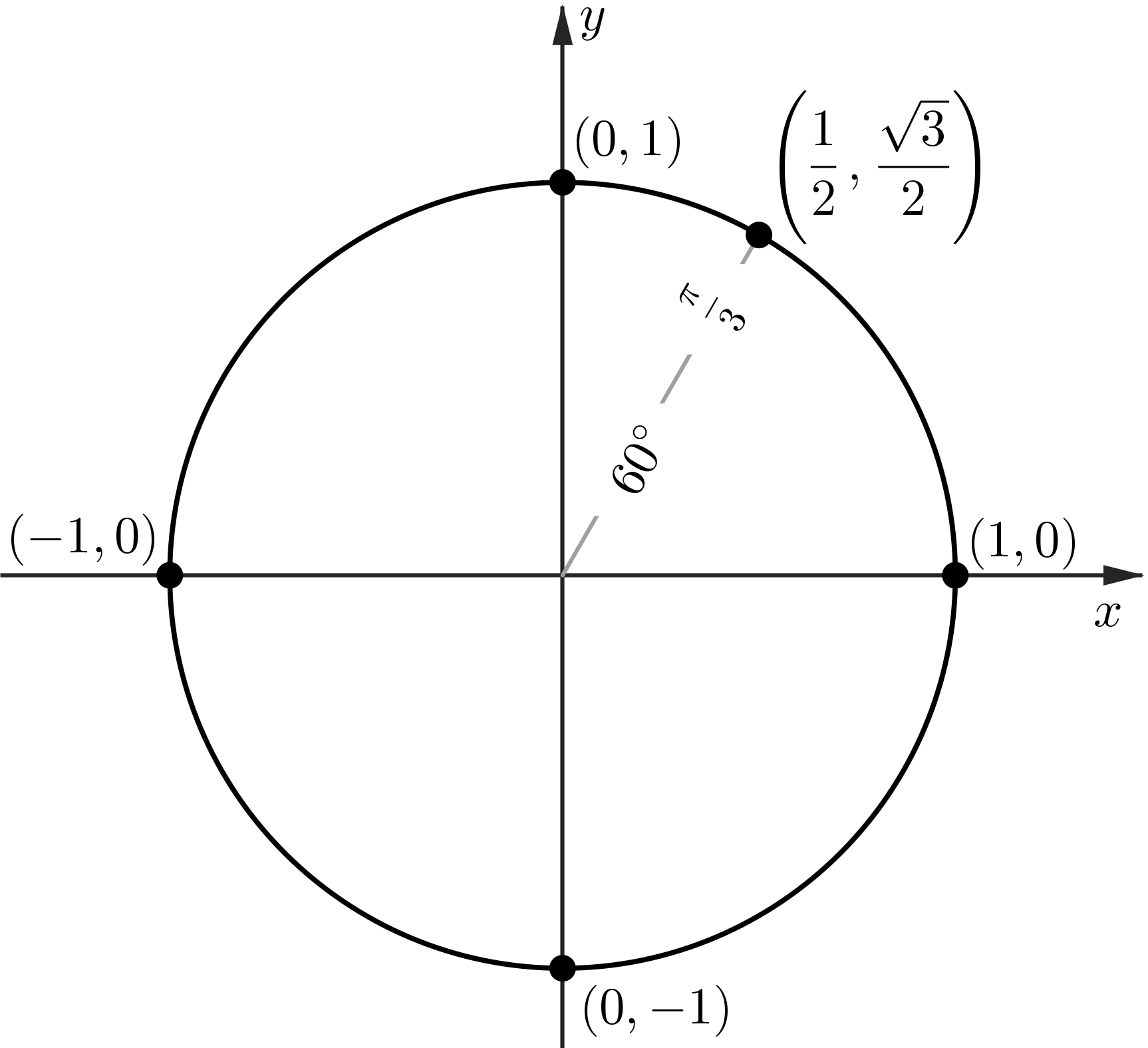
\(\sin \left(\dfrac{\pi}{3}\right)\) \(=\dfrac{\sqrt{3}}{2},\;\;\) \(\cos \left(\dfrac{\pi}{3}\right)\) \(= \dfrac{1}{2},\;\;\) \(\tan \left(\dfrac{\pi}{3}\right)\) \(= \dfrac{\sqrt{3}}{1}\)
Special Triangles
|
|
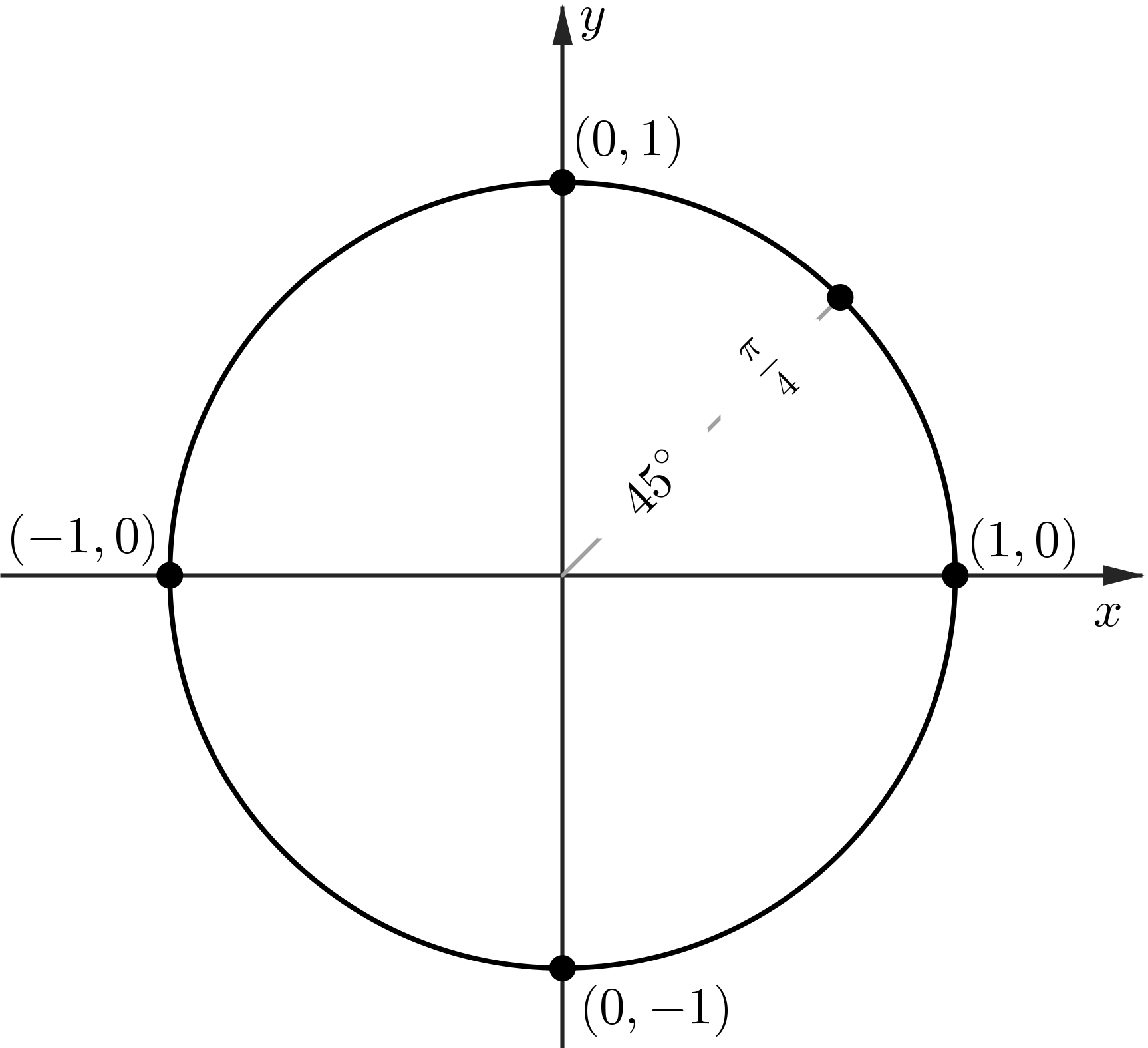
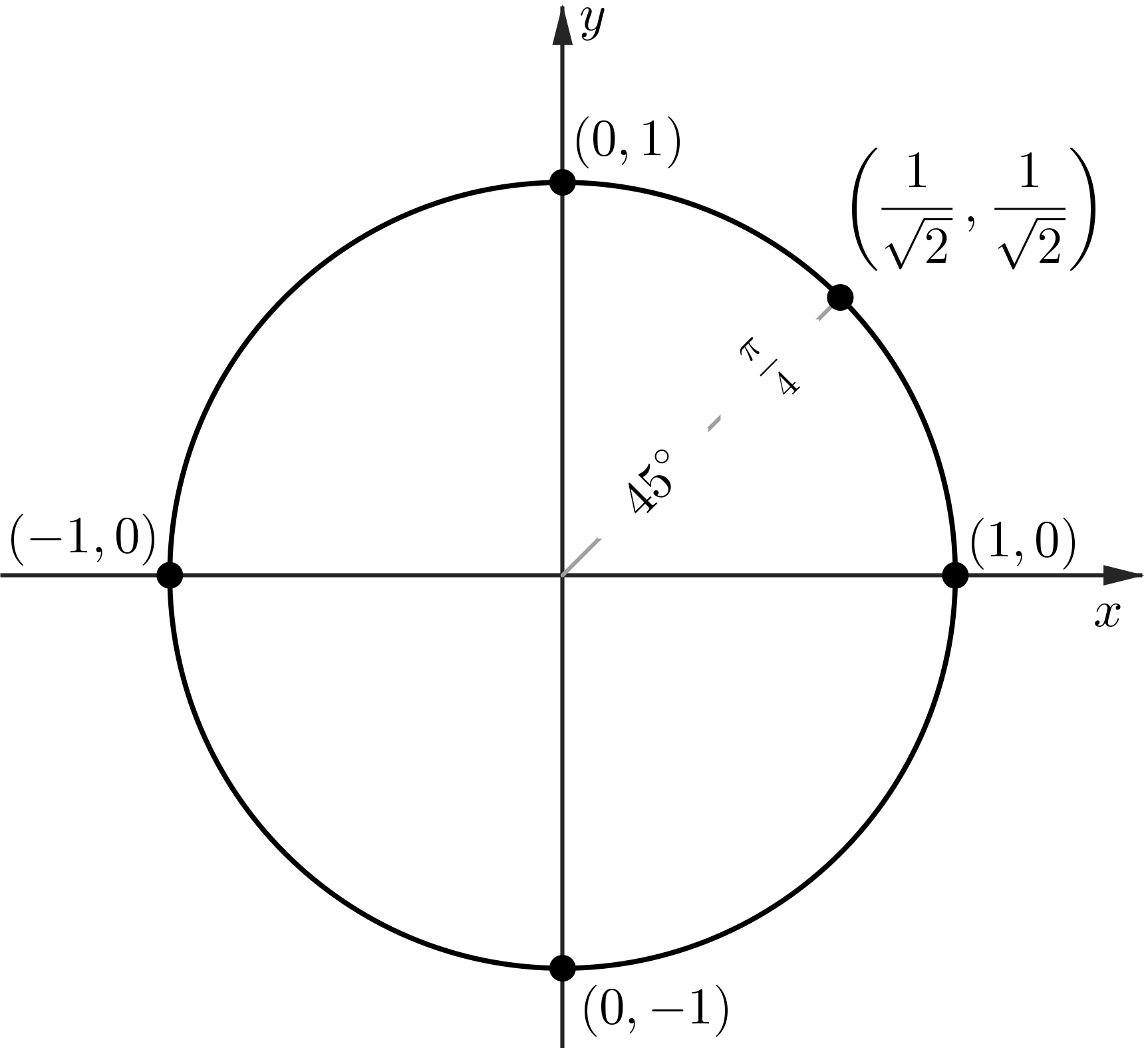
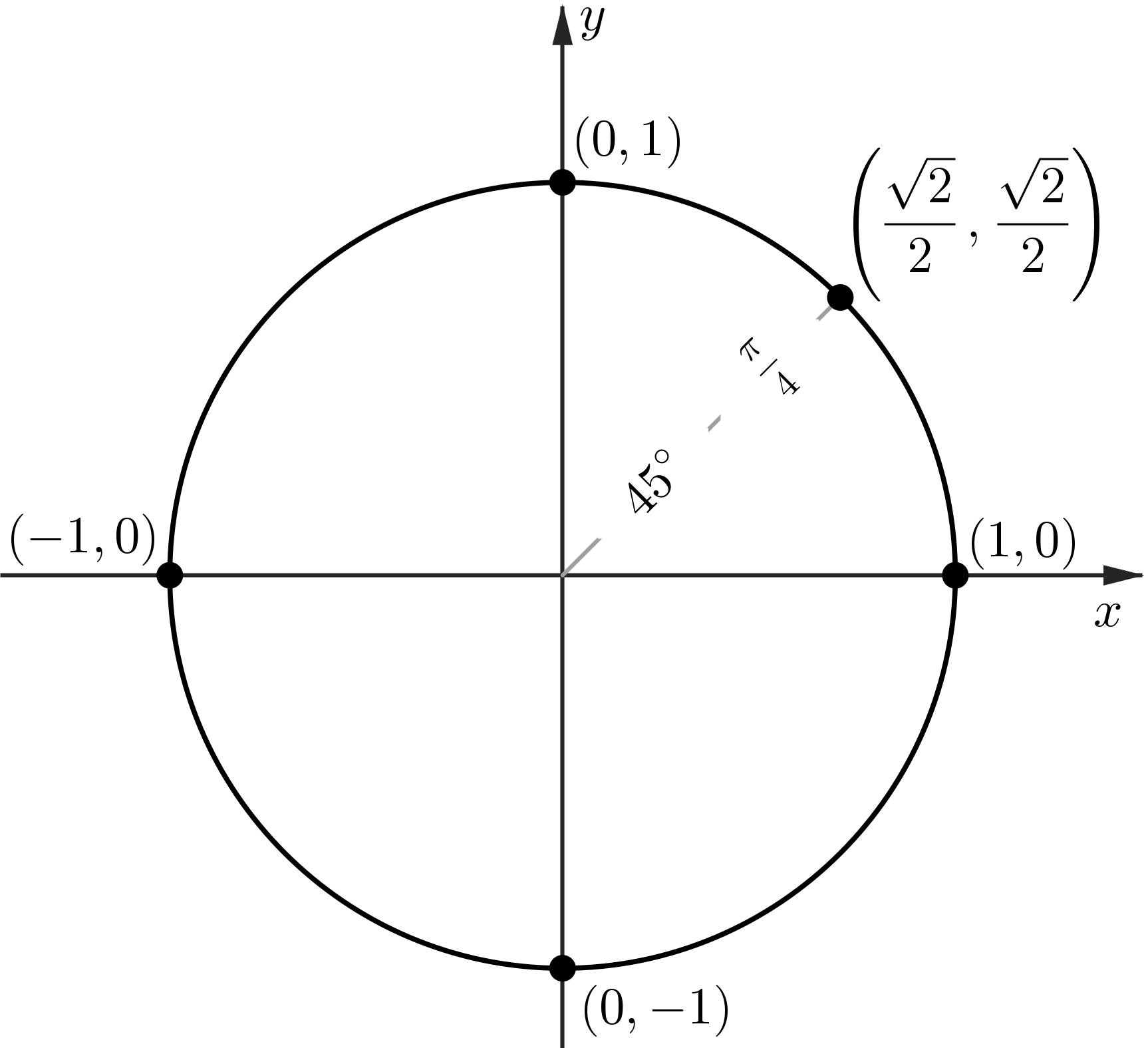
\(\sin \left(\dfrac{\pi}{4}\right)\) \(=\dfrac{1}{\sqrt{2}}\) \(=\dfrac{\sqrt{2}}{2}\) \(\cos \left(\dfrac{\pi}{4}\right)\) \(=\dfrac{1}{\sqrt{2}}\) \(=\dfrac{\sqrt{2}}{2}\) \(\tan \left(\dfrac{\pi}{4}\right)\) \(=\dfrac{1}{1} \) \(=1 \) |
Special Triangles
We can compute some exact values of $\sin$/$\cos$/$\tan$
|
|
|
|
|
|
Special Triangles
But what if the angle is something other than
30, 45, or 60 degrees?
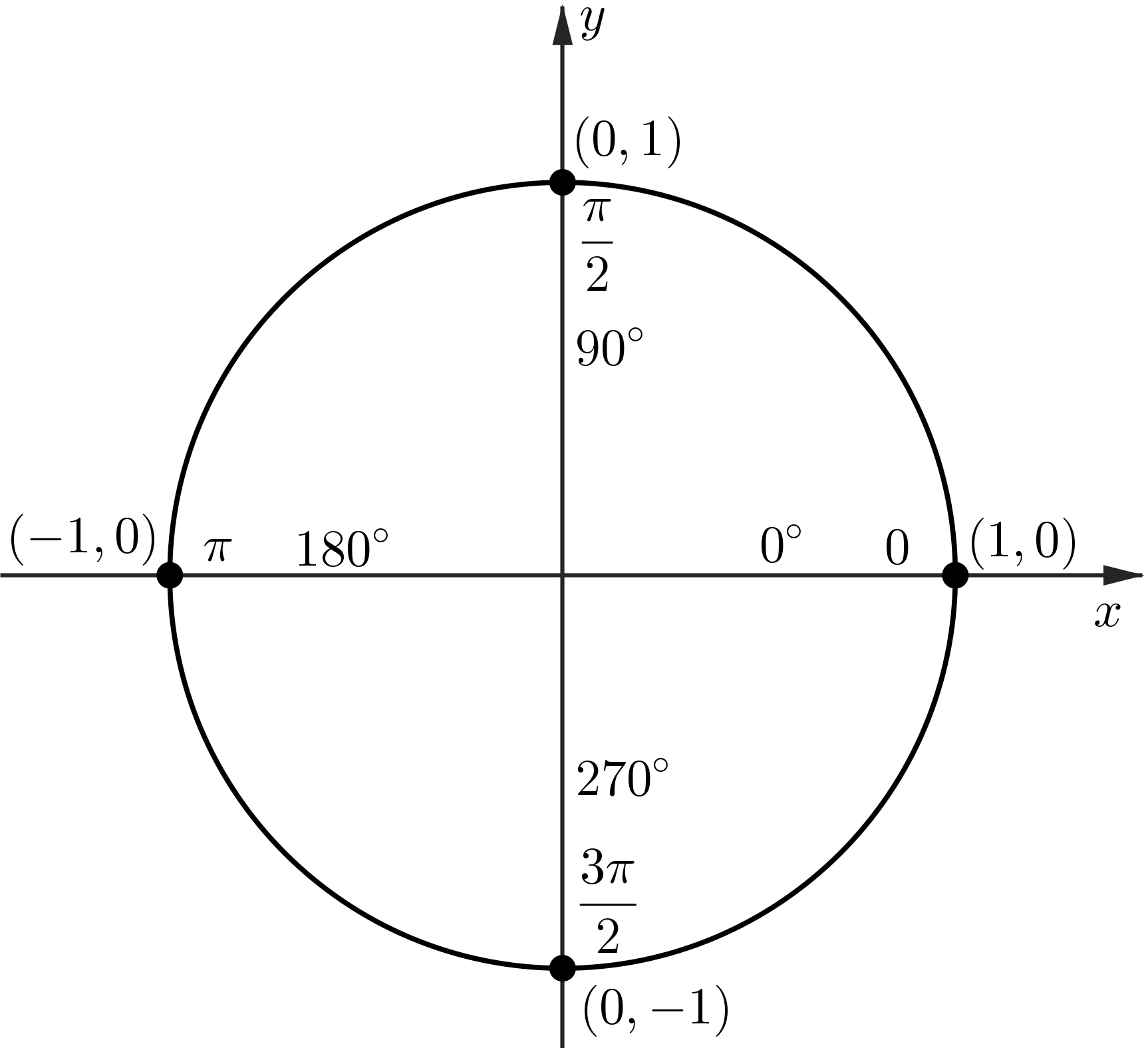
The Unit Circle
The Unit Circle
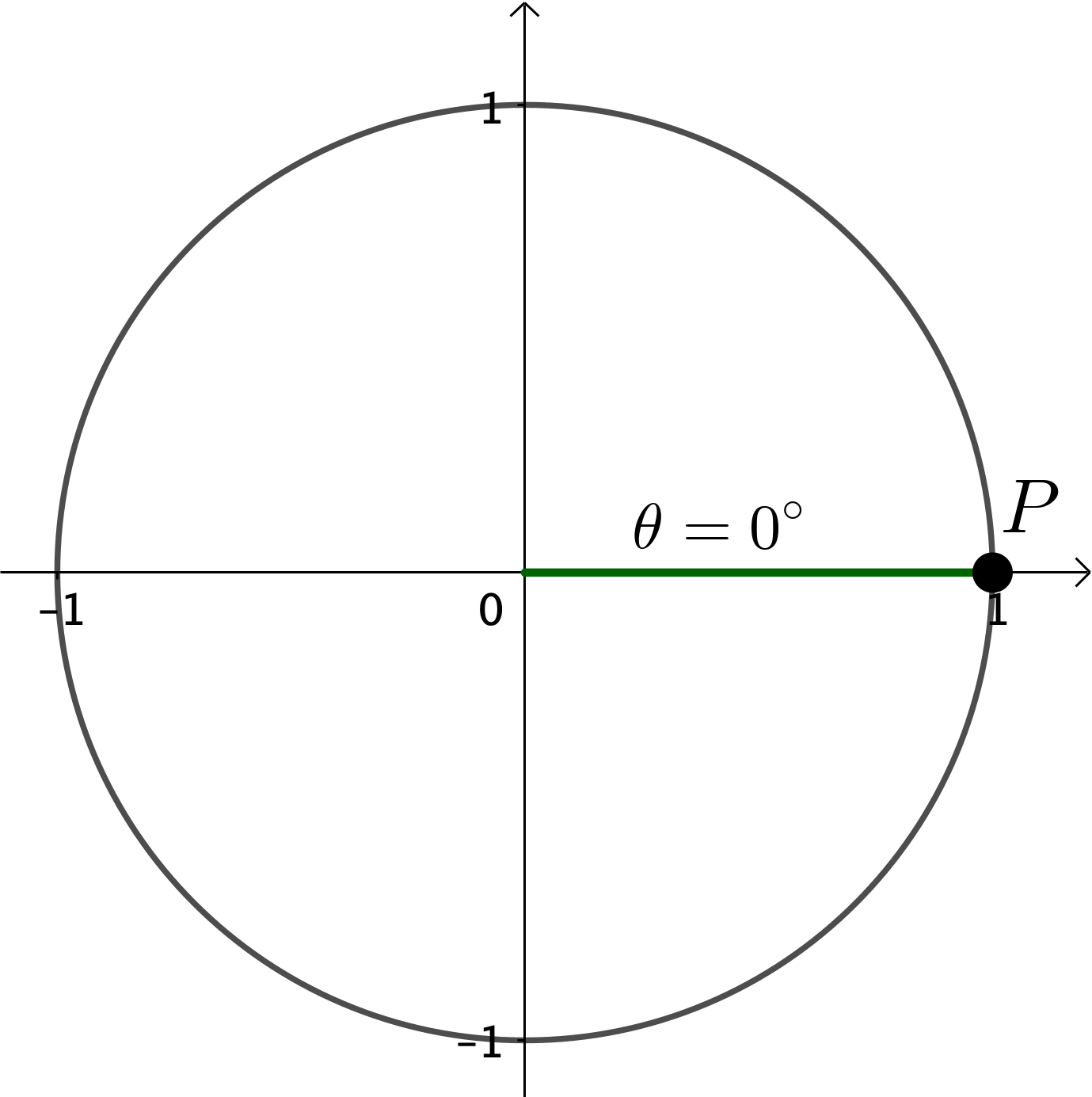
|
\(P = \left(\cos \theta, \sin \theta\right)\) \(\;\;\; = \left(\cos 0^{\circ}, \sin 0^{\circ}\right)\) \(\;\;\; = \left(1, 0\right)\) |
The Unit Circle
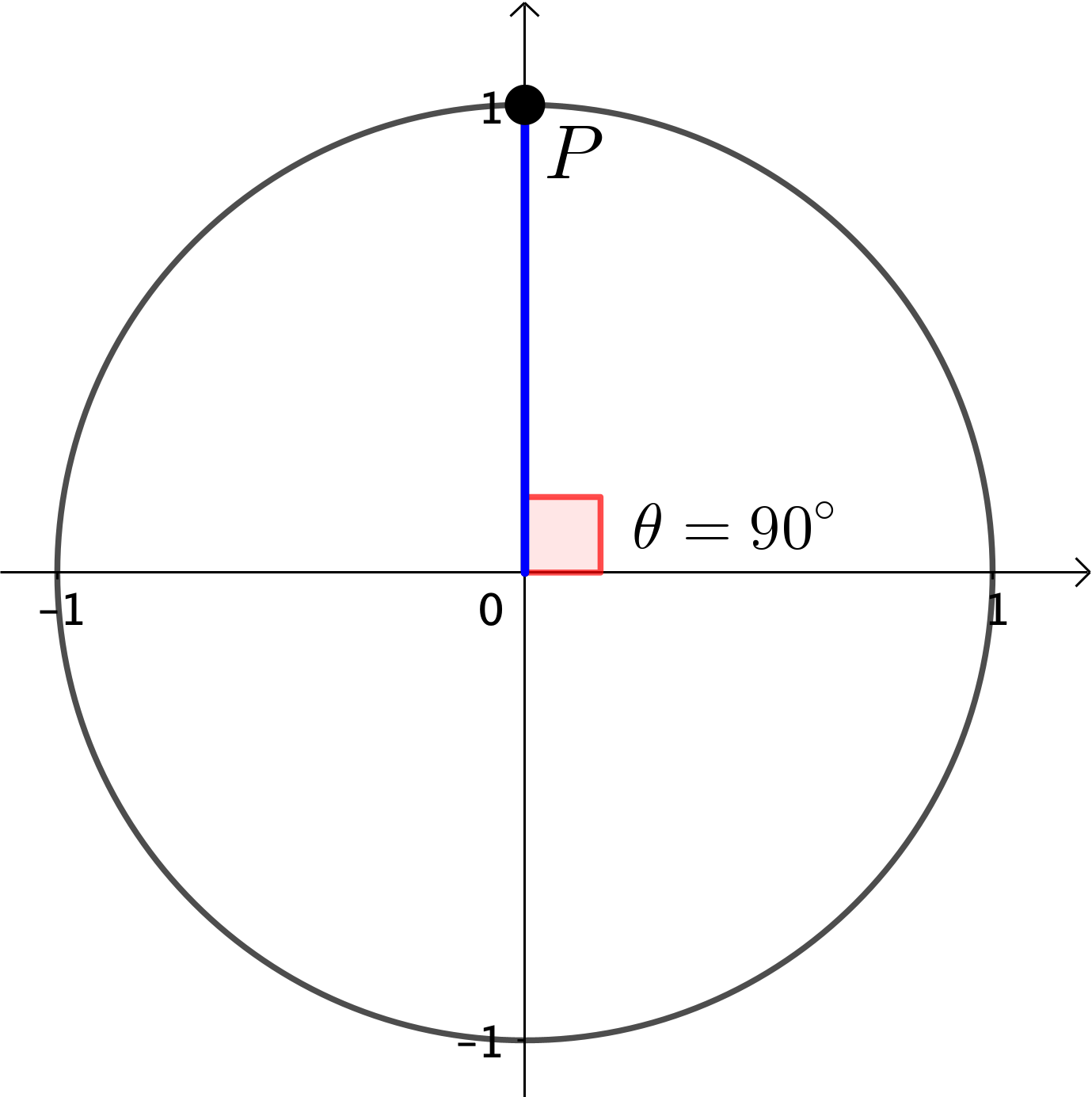
|
\(P = \left(\cos \theta, \sin \theta\right)\) \(\;\;\; = \left(\cos 90^{\circ}, \sin 90^{\circ}\right)\) \(\;\;\; = \left(0, 1\right)\) |
The Unit Circle
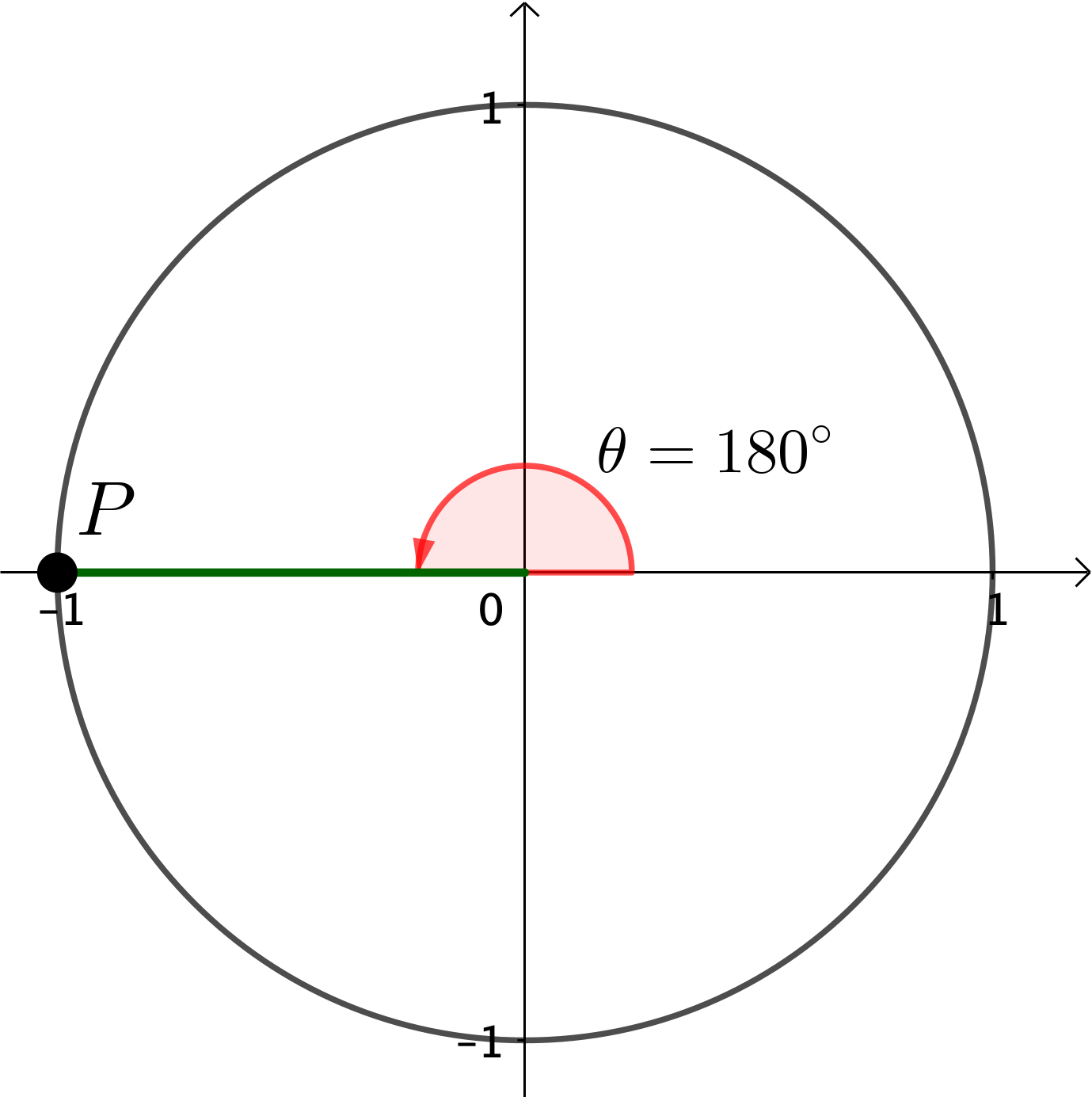
|
\(P = \left(\cos \theta, \sin \theta\right)\) \(\;\;\; = \left(\cos 180^{\circ}, \sin 180^{\circ}\right)\) \(\;\;\; = \left(-1, 0\right)\) |
The Unit Circle
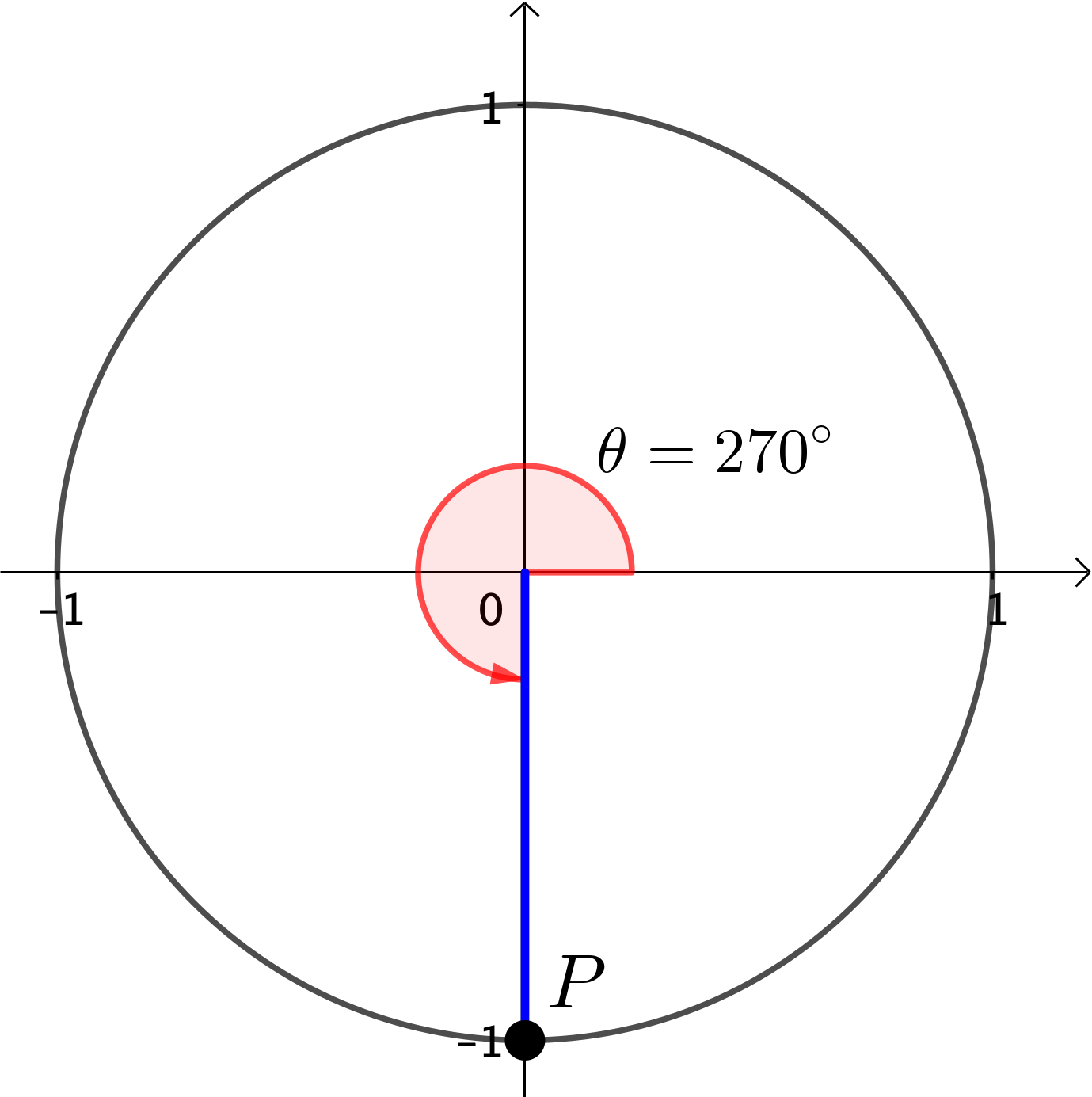
|
\(P = \left(\cos \theta, \sin \theta\right)\) \(\;\;\; = \left(\cos 270^{\circ}, \sin 270^{\circ}\right)\) \(\;\;\; = \left(0, -1\right)\) |
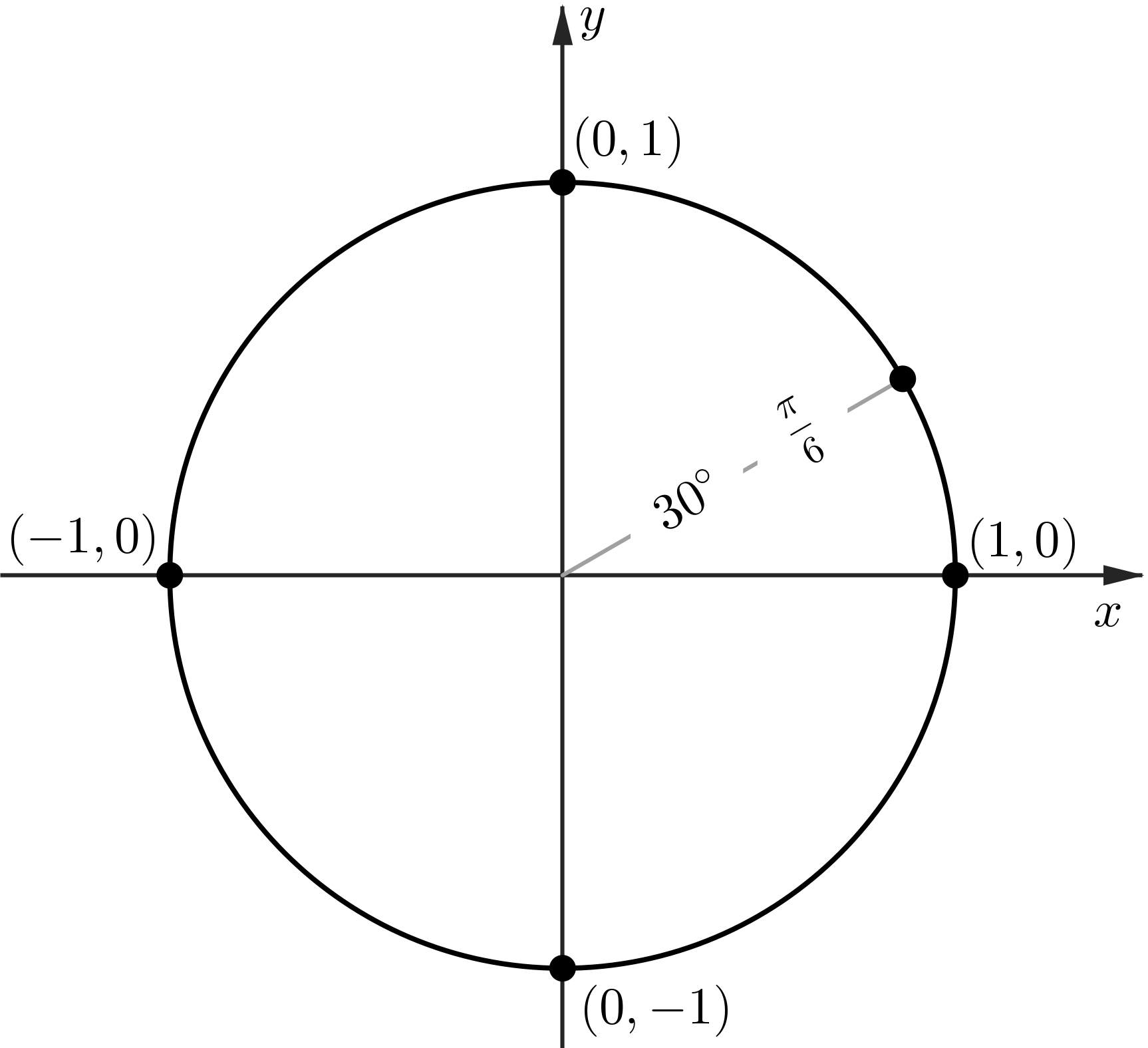
The Unit Circle: sin and cos at $30^\circ$
|

|
The Unit Circle: sin and cos at $45^\circ$
|

|
The Unit Circle: sin and cos at $60^\circ$
|
|
The Unit Circle
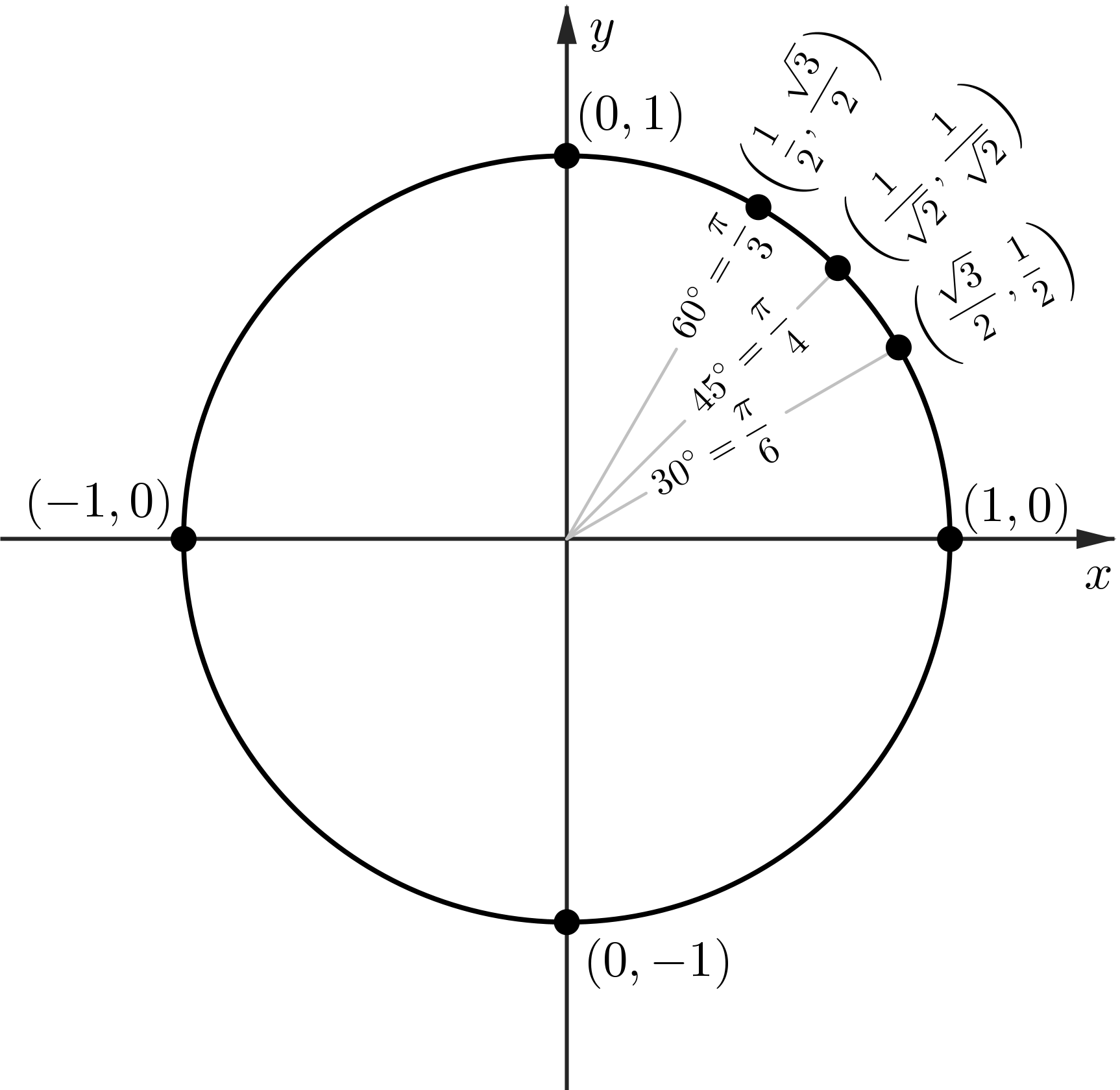
The Unit Circle
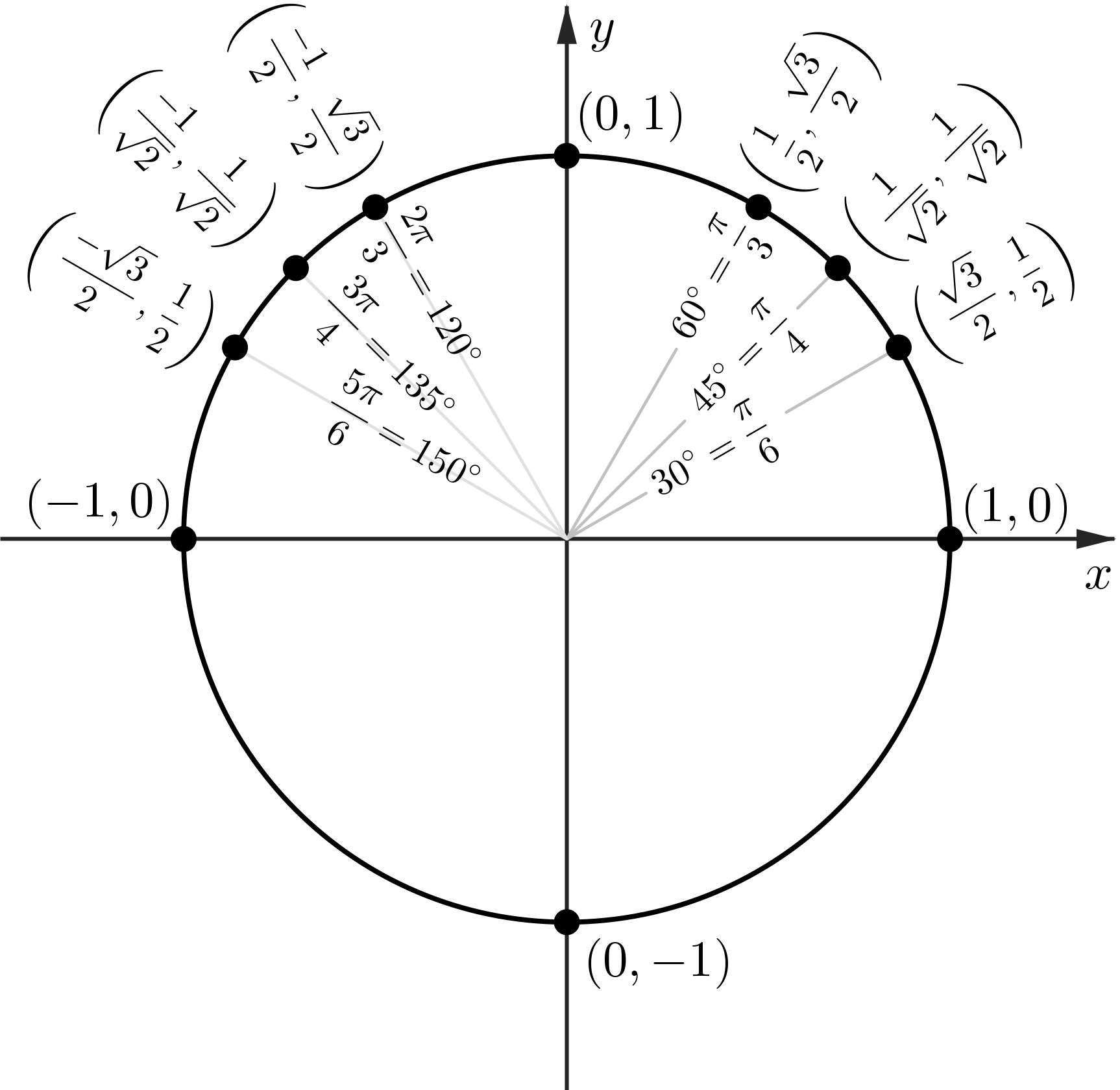
The Unit Circle
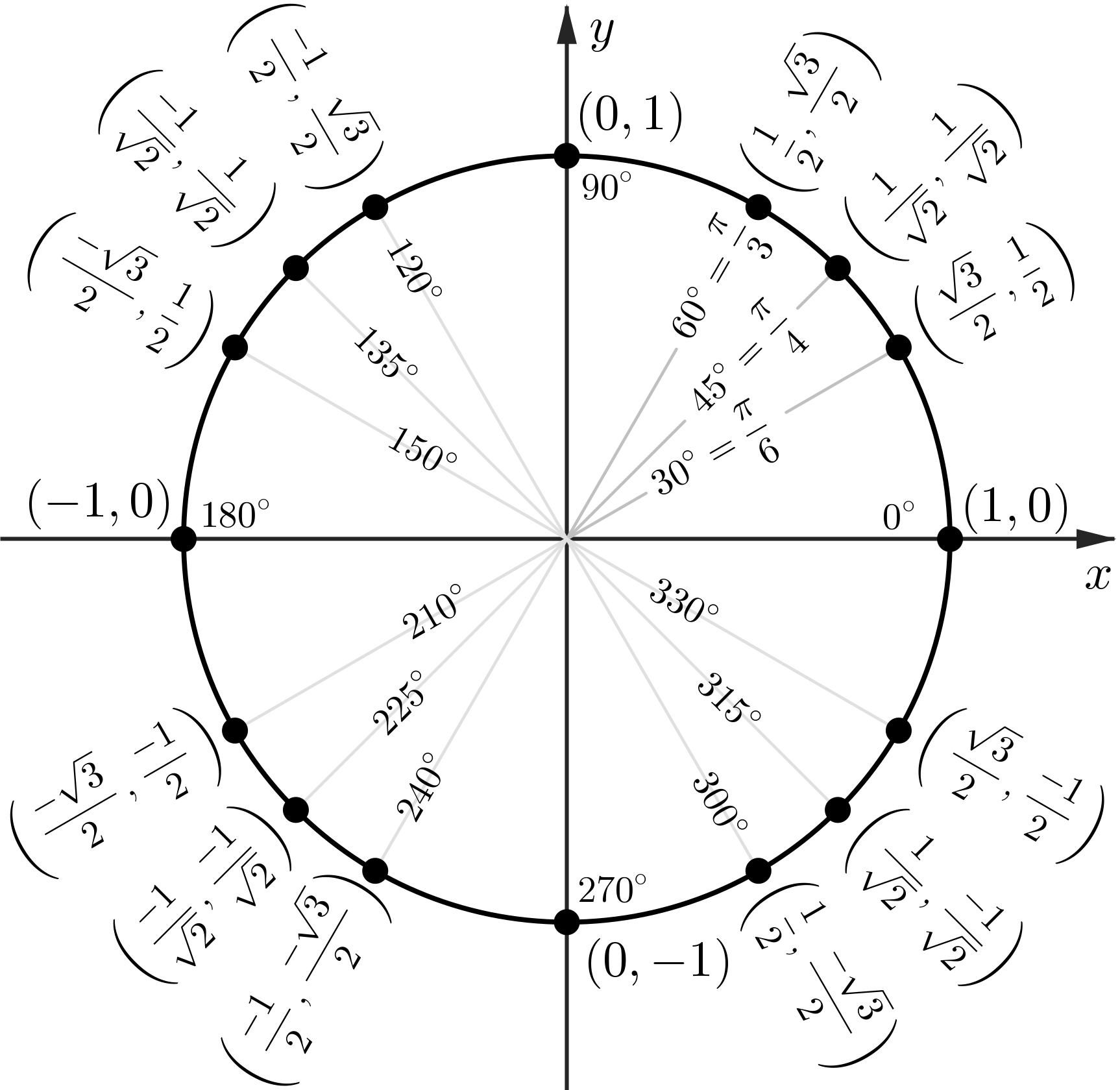
The Unit Circle
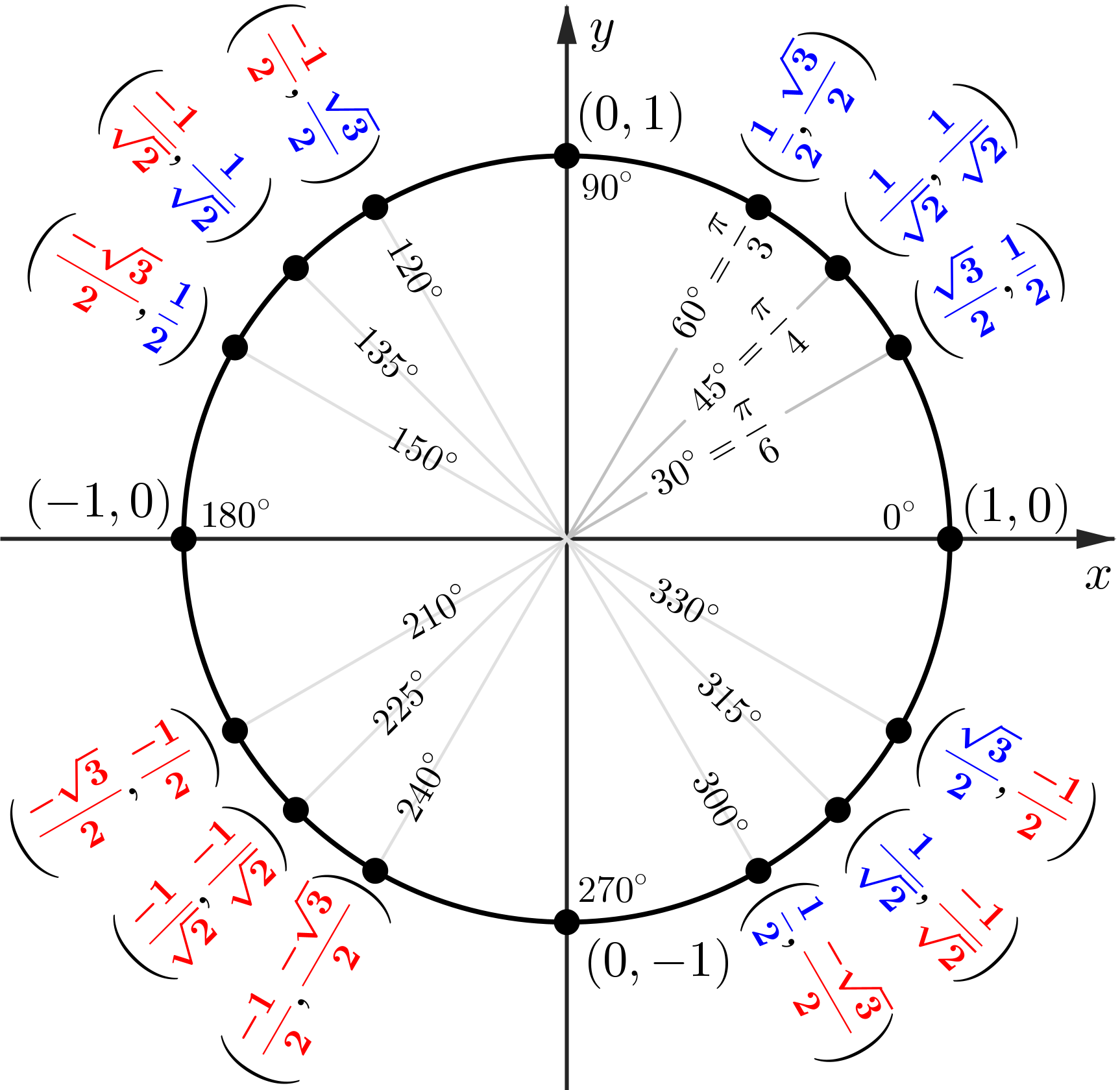
Like and Unlike terms
| $3x$ and $5x$ | Like terms ✅ |
| $4y$ and $-9y$ | Like terms ✅ |
| $2x$ and $2y$ | Unlike terms ❌ |
| $2x^2$ and $6x$ | Unlike terms ❌ |
| $7x^3$ and $-5x^3$ | Like terms ✅ |
| $8x^2y^3$ and $14x^2y^3$ | Like terms ✅ |
If possible, simplify!
| $8x+3x$ | $=\;11x$ $\;\; \ra\;$ 8🍎 + 3🍎 = 11🍎 |
| $9y-5y$ | $=\;4y$ |
| $4a+4b$ | Unlike terms ❌ |
| $3x^3+6x+2x$ | $=\;3x^3+8x$ |
| $4y^4-y^4+6y^3$ | $=\;3y^4+6y^3$ |
| $2x^5y^2z^3+3x^5y^2z^{-3}$ | Unlike terms ❌ |
Last example
Consider the algebraic expression: $4x^2-5x^2+8x-2$
How many terms are in the expression? There are $4$ terms!
What is the coefficient of $x^3$? The coefficient is $4.$
What is the constant term? The constant term is $-2.$
If $x=3,$ what is the value of the expression?
$\qquad \qquad \Ra 4(3)^2-5(3)^2+8(3)-2$ $=85.$
If $x=-2,$ what is the value of the expression?
$\qquad \qquad \Ra 4(-2)^2-5(-2)^2+8(-2)-2$ $=-70.$
What is next?
- Prepare for Progress Test 1.
-
Watch the week 4 video content before your
scheduled week 4 workshop.