
Foundation Mathematics
1017SCG
Lecture 4
Topics for Week 4
- Expanding
- Factoring
Expanding
Recall the order of operations
BIDMAS
Consider
$x(x+1)$ $=x\times x $ $+\, x\times 1$
$\;\;\;=x^2 + x$
Distributive law
$a(b+c)$ $=a\times b $ $+ \,a\times c$
$\;\;\;\;=ab + bc$
Examples
Distributive law: $\;a(b+c)=ab + bc$
|
$2\times (5+3)$ $=2\times 8$ $\;\;\quad\qquad =16$ |
$2\times (5+3)$ $=2\times 5 + 2 \times 3$ $\qquad\;=10+36$ $\;\;=16$ |
More examples with algebraic expressions
In our previous example:
$x(x+1)$ $=x\times x + x\times 1\qquad $
$\;\;\,\qquad\qquad \qquad =x^2 + x$ $\qquad $Unlike terms👈
Expand
$2x(4x+3)$ $=2x\times 4x$ $+\, 2x\times 3\qquad \qquad \qquad$
$\qquad \quad\,=8x^2 + 6x$ $\qquad $Unlike terms👈
More examples with algebraic expressions
Expand
$x^2(3y+2x)$ $=x^2\times 3y + x^2\times 2x\qquad \qquad \qquad$
$\quad\qquad \quad=3x^2y + 2x^3$ $\qquad $Unlike terms👈
$5x(x-3)$ $=5x\times x - 5x \times 3\qquad \qquad \qquad$
$\;\;\qquad \quad=5x^2 -15x$ $\qquad $Unlike terms👈
More examples with algebraic terms
Expand
$4x(x^2-3)$ $=4x\times x^2 - 4x\times 3\qquad \qquad \qquad\;\;$
$\qquad \quad=4x^3 - 12x$ $\qquad $Unlike terms👈
$-5x(x-6)$ $=-5x\times x + 5x \times 6\qquad \qquad \qquad\;\;$
$\quad \qquad \;\;=-5x^2 +30x$ $\qquad $Unlike terms👈
Consider now the following
$(a+b)(c+d)$ $= a\times c $ $+\, a\times d $ $+\, b\times c $ $+ \,b\times d\quad \;$
$= a c + a d + b c + bd$
$(x+1)(x+2)$ $= x\times x $ $+ \, x\times 2 $ $+\, 1\times x$ $ +\, 1\times 2\qquad\qquad$
$\qquad \quad\;\;= x^2 + 2x +x + 2$ $\qquad $Like terms👈
$\quad\qquad = x^2 + 3x + 2$ $\qquad $Unlike terms👈
Practice
$(4x-1)(x+2)$ $= 4x\times x + 4x\times 2 -1\times x -1\times 2\qquad\qquad\;\;$
$\qquad \quad\;\;= 4x^2 + 8x - x - 2\;\;$ $\qquad $Like terms 👈
$\;\;\qquad = 4x^2 + 7x - 2$ $\qquad $Unlike terms 👈
$(x-4)^2$ $= (x-4)(x-4)\qquad\qquad \qquad \qquad \qquad \qquad \qquad$
$= x\times x + x\times (-4) + (-4)\times x + (-4)\times (-4)\quad $
$= x^2 - 4x - 4x + 16\qquad$ $\qquad $Like terms 👈
$= x^2 - 8x + 16\quad\qquad $ $\qquad $Unlike terms 👈
Factorising
Factorising
Previously we did expansion:
$4(x+1)$ $=4\times x$ $+\,4\times 1 $
$\quad = 4x+4$
Factorising:
$4x+4$ $=4\times x$ $+\,4\times 1 $
$\quad = 4(x+1)$
Factorise
$6x+8$ $= 2\times 3 x $ $ +\, 2 \times 4$
$\quad =2(3x+4)$
$x^2+3x$ $=x$ $\left(\right.$ $x$ $+\,3$ $\left.\right)$
$4x^2+8x$ $=4x$ $\left(\right.$ $x$ $+\,2$ $\left.\right)$
$6x-9$ $=3$ $\left(\right.$ $2x$ $-\,3$ $\left.\right)$
$9x^3-8x^2$ $=x^2$ $\left(\right.$ $9x$ $-\,8$ $\left.\right)$
Difference of Two Squares
$a^2 - b^2 $ $=(a+b)(a-b)$
We can check this by expanding:
$(a+b)(a-b)$ $=a\times a $ $-\, a\times b $ $+\, b\times a $ $-\, b\times b $
$\quad =a^2 $ $-\, ab $ $+\, b a $ $-\, b^2 $
$\quad =a^2 $ $-\, ab $ $+\, a b $ $-\, b^2 $
$=a^2-b^2\qquad\;\; $
📝 Practice: Factorise
$x^2-16$ $=x^2-4^2 \qquad \qquad \quad\; $
$=\left(x+4\right)$ $\left(x-4\right)$
$9x^2-25$ $=(3x)^2-5^2 \qquad \qquad \quad\;\;$
$=\left(3x+5\right)$ $\left(3x-5\right)$
$2x^2-8$ $=2(x^2-4)$ $=2(x^2-2^2)$
$\;\;\,=2\left(x+2\right)$ $\left(x-2\right)$
Methods for factorising
1. Common factor
$\qquad 6x+ 8 = 2(3x+4) $
2. Difference of Two Squares
$\qquad 2x^2-8=2\left(x+2\right)\left(x-2\right)$
3. Cross method
Methods for factorising
3. Cross method
$\qquad x^2+3x+2$ $=\left(\right.$ $x+2$ $\left.\right)$ $\left(\right.$ $x+1$ $\left.\right)$
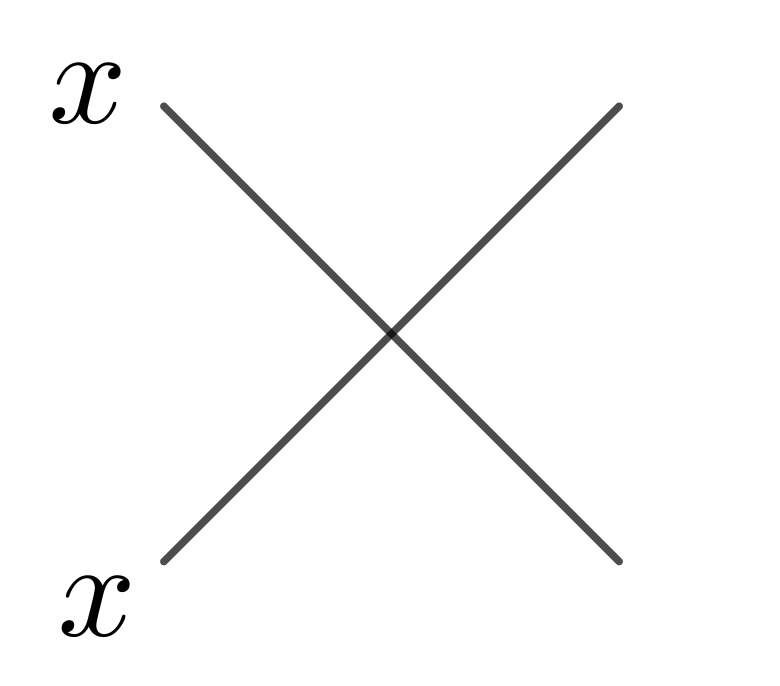
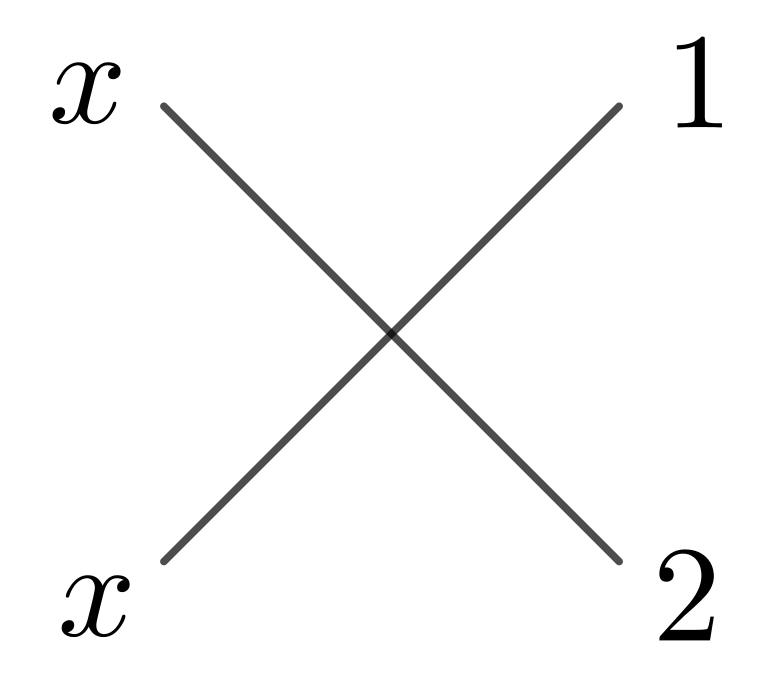
Methods for factorising
3. Cross method
$\qquad x^2+3x+2$ $=\left(\right.$ $x+2$ $\left.\right)$ $\left(\right.$ $x+1$ $\left.\right)$
Check by expanding
$\qquad (x+2)(x+1)$ $=x^2$ $+\, x$ $+\, 2x$ $+\, 2$
$\qquad \qquad \qquad \quad\, =x^2+3x+2$ $\quad$ ✅
Methods for factorising
3. Cross method
$\qquad x^2+4x-5$ $=\left(\right.$ $x-1$ $\left.\right)$ $\left(\right.$ $x+5$ $\left.\right)$
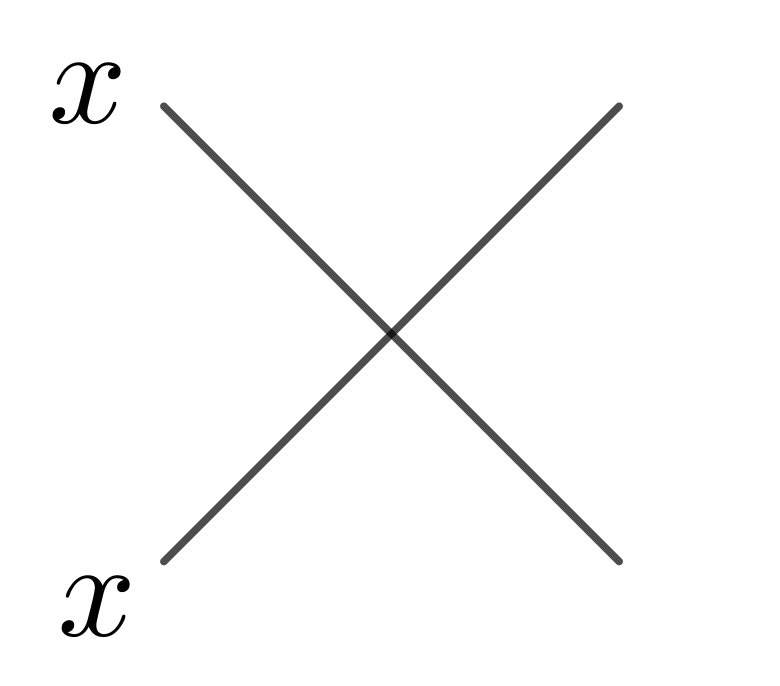
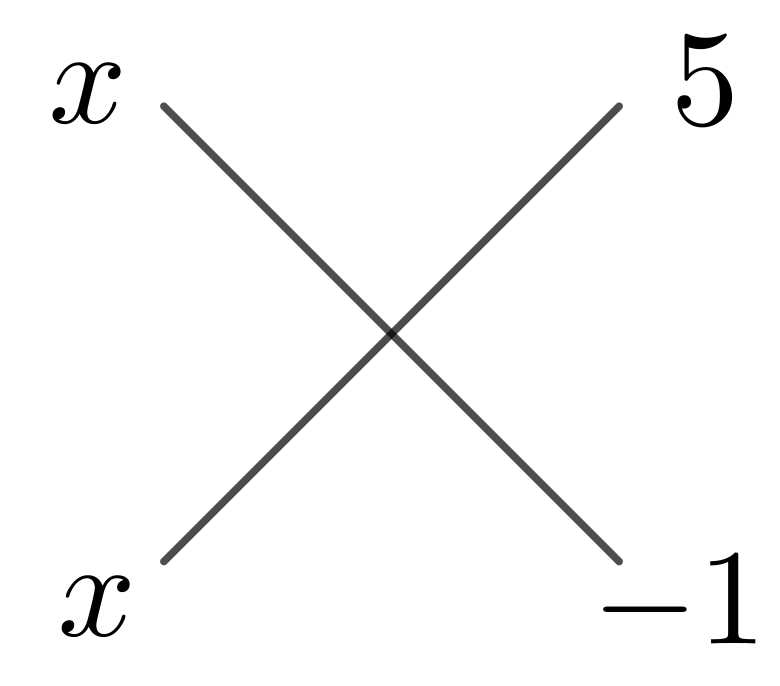
Methods for factorising
3. Cross method
$\qquad x^2+4x-5$ $=\left(\right.$ $x-1$ $\left.\right)$ $\left(\right.$ $x+5$ $\left.\right)$
Check by expanding
$\qquad (x-1)(x+5)$ $=x^2$ $+\, 5x$ $-\, x$ $-\, 5$
$\qquad \qquad \qquad \quad\, =x^2+4x-5$ $\quad$ ✅
📝 Practice
Simplify
$\dfrac{x+2}{x^2+7x +10}$ $=\dfrac{x+2}{(x+2)(x+5)}\qquad $
$=\dfrac{1}{x+5}$
Methods for factorising
1. Common factor
$\qquad 6x+ 8 = 2(3x+4) $
2. Difference of Two Squares
$\qquad 2x^2-8=2\left(x+2\right)\left(x-2\right)$
3. Cross method
$\qquad x^2+4x-5 = (x-1)(x+5)$
👉Always check answer to see if it can be factorised further!