
Calculus I
&
Engineering Mathematics 2
Workshop 9
Ordinary Differential Equations
Source: Falling |
\[ m \frac{dV}{dt} =m\,g - k V \] More info: Newton's second law of motion: $F=ma$ |
Ordinary Differential Equations
|
|
$\ds m \frac{d^2x}{dt^2} = -k\, x(t) $ More info: Free, Undamped Vibrations |
Ordinary Differential Equations
|
|
$\ds x''(t) + \frac{\beta}{m}x'(t) + \frac{k}{m}x(t) =0$ More info: Free, Damped Vibrations |
Ordinary Differential Equations
|
|
\(\ds \frac{d^2\theta(t) }{dt^2} = -\mu\frac{d\theta (t)}{dt}-\frac{g}{L} \sin \left(\theta(t)\right) \) More info: Pendulum (mechanics) |
Ordinary Differential Equations
\(\ds \frac{d^2\theta_i }{dt^2} =-\frac{g}{L_i}\sin \theta_i \)
Ordinary Differential Equations
\[ \begin{eqnarray} \theta_1'' & = & \frac{-g\left(2m_1+m_2\right)\sin \theta_1 - m_2 g \sin\left(\theta_1 - 2 \theta_2\right) - 2\sin\left(\theta_1 - \theta_2\right)\,m_2 \big[\theta_2'^2 L_2 + \theta_1'^2L_1 \cos\left(\theta_1 - \theta_2\right)\big]}{L_1\big[2m_1+m_3-m_2\cos \left(2\theta_1 - 2 \theta_2\right) \big]}\\ \theta_2'' & = & \frac{ 2\sin\left(\theta_1 - \theta_2\right) \big[ \theta_1'^2L_1(m_1+m_2) + g (m_1+m_2) \cos \theta_1 + \theta_2'^2L_2m_2\cos\left(\theta_1 - \theta_2\right) \big]}{L_2\big[2m_1+m_3-m_2\cos \left(2\theta_1 - 2 \theta_2\right) \big]}\\ \end{eqnarray} \]
Source: www.myphysicslab.com
Ordinary Differential Equations
First and second order ODEs are amazing! 😎
However, they are really freaking hard to solve!
|

$x^2\dfrac{d^2y}{dx^2} + x\dfrac{dy}{dx} + \left(x^2-\alpha^2 \right) y = 0,$ $\alpha \in \C.$ |
Ordinary Differential Equations
It gets even more complicated when we consider
Partial Differential Equations
For example, Laplace equation
$\dfrac{\partial^2u }{\partial x^2} + \dfrac{\partial^2u}{\partial y^2}+
\dfrac{\partial^2u }{\partial z^2}=0$
Ordinary Differential Equations
It gets even more complicated when we consider
Partial Differential Equations
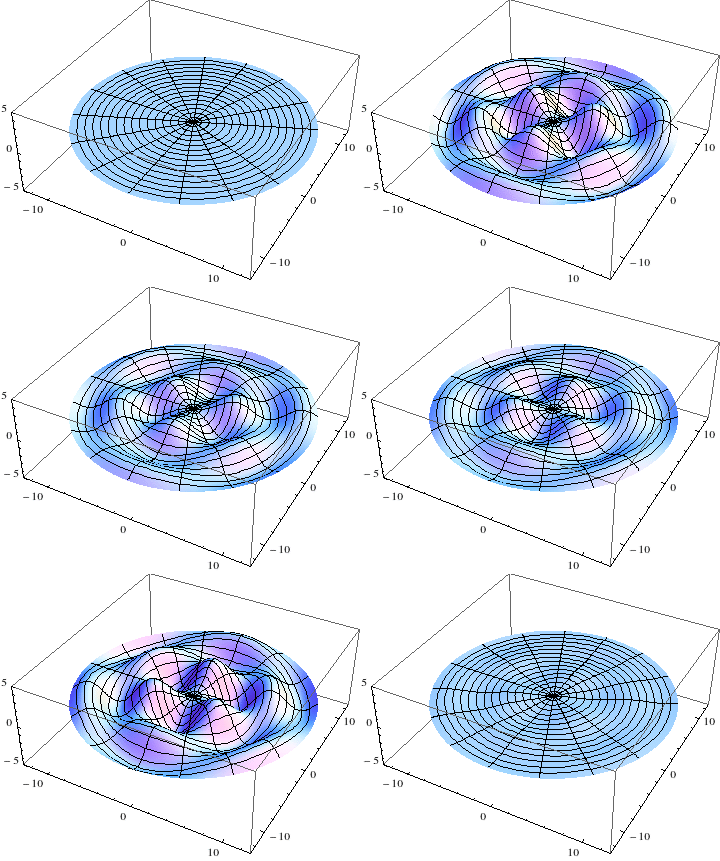
|
Simulation by: Konstantin Makhmutov |
Chladni Figures: Source 1: Sophie Germain (1821). Recherches sur la théorie des surfaces élastiques Source 2: I. Todhunter (2014). Karl Pearson (ed.). A History of the Theory of Elasticity and of the Strength of Materials: Volume 1. Cambridge University Press. p. 153. Source 3: S. P. Timoshenko, (1953). History of Strength of Materials - With a Brief Account of the History of Theory of Elasticity and Theory of Structures Dover Publications, Inc. NY., Chapter V. |
Ordinary Differential Equations
It gets even more complicated when we consider
Partial Differential Equations
Another example: Navier-Stokes equations (imcompressible)
\( \ds\rho \left(\frac{\partial \v}{\partial t} + \v \cdot \nabla \v \right) = -\nabla p + \mu \nabla^2 \v + \F, \quad \nabla \cdot \v = 0. \)
Ordinary Differential Equations
Another example: Navier-Stokes equations (imcompressible)
\( \ds\rho \left(\frac{\partial \v}{\partial t} + \v \cdot \nabla \v \right) = -\nabla p + \mu \nabla^2 \v + \F, \quad \nabla \cdot \v = 0. \)
Fluid simulation by Amanda Ghassaei 🔄 (Reset/Re-start)
Ordinary Differential Equations
A first-order ODE is called separable if it can be written in the form
$\ds \dif{y}{x} = f(x)\,g(y).$
$\ds \dif{y}{t} = f(t)\,g(y),\;\;$ $\ds \dif{y}{\theta} = f(\theta)\,g(y),\;\;$ $\ds \dif{T}{t} = f(t)\,g(T).$
Solving separable ODEs
$\ds \dif{y}{x} = f(x)\,g(y).$
- Rewrite the equation as $\,\displaystyle \frac{1}{g(y)}\,\dif{y}{x} = f(x).$
-
Integrate both sides with respect to $x$:
$\,\displaystyle \int\frac{1}{g(y)}\,\dif{y}{x}\, \dup x = \int f(x) \dup x.$
- Note the integral on the left is a "substitution", so that we can replace the last equation by $\;\displaystyle \int\frac{\dup y}{g(y)} = \int f(x) \dup x. $
- If we are lucky one or both of the integrals can actually be computed.
- Extra step: If we are even more lucky we can then finally explicitly express $y$ as a function of $x$.
Solving separable ODEs
Example: Solve the ODE $\;\ds \dif{y}{x}=\frac{x}{y}$.
|
$\ds \frac{dy}{dx} = x\left(\frac{1}{y}\right)$
|
1. $\ds y \frac{dy}{dx} = x$ 2. $\ds \int y \frac{dy}{dx} ~dx= \int x ~dx$ $\;\Ra\ds \int y ~dy = \int x~dx $ $\quad\Ra\; \ds \frac{y^2}{2}= \frac{x^2}{2}+C \;$ $\Ra\; y^2 = x^2 + K $ 3. Extra step: $ \,y = \pm \sqrt{x^2+ K} $ 📝 |
Solving separable ODEs
If $\,\ds\dif{y}{x}=\frac{x}{y},\,$ then $\,y^2 = x^2 + K $ or $ \,y = \pm \sqrt{x^2+ K} $
The solution we found for the above example
contains an arbitrary constant. So this is
the general solution.
In the case of an Initial Value Problem (IVP)
this constant will be fixed
to find one, particular solution.
Example: Solve the IVP $\;\displaystyle{\dif{y}{x}=\frac{x}{y}},$ $\, y(0)=3.$
Solving separable ODEs
Example: Solve the IVP $\;\displaystyle{\dif{y}{x}=\frac{x}{y}},$ $\, y(0)=3.$
We know that $y^2 = x^2 + K$ is the general solution.
Consider the initial condition $y(0)=3.$ That is
$\qquad \qquad\,{\underbrace{(3)^2}_{y^2}}=\underbrace{(0)^2}_{x^2}+ K$ $\;\Ra\; K = 9\,$ $\;\Ra\; y = \pm \sqrt{x^2+9}.$
Here we need to take the $+$ sign since $\,y(0)=3.$
Therefore $\,y = \sqrt{x^2+9}\,$ is the solution to the IVP.
Steps to solve separable ODEs: $\ds \,\dif{y}{x} = f(x)\,g(y).$
- Rewrite the equation as $\,\displaystyle \frac{1}{g(y)}\,\dif{y}{x} = f(x).$
-
Integrate both sides with respect to $x$:
$\displaystyle \int\frac{1}{g(y)}\,\dif{y}{x}\, \dup x = \int f(x) \dup x\;$ $\iff$ $\displaystyle \int\frac{\dup y}{g(y)} = \int f(x) \dup x. $
- Extra step: If possible, explicitly express $y$ as a function of $x$.