
Linear Algebra & Applications
2201NSC
Introduction

What is Linear Algebra?
Algebra involves the use of the algebraic operations $(\times)$ and $(+)$ on mathematical objects like numbers, vectors, matrices, or functions.
A linear operation $\large ℒ$ is one that obeys the relationships
Additivity: $ {\large ℒ}\left(x+ y \right) = {\large ℒ}(x)+{\large ℒ}(y).$
Homogeneity: $ {\large ℒ}\left(\alpha x\right) =\alpha {\large ℒ}(x).$
Linear Algebra begins by considering linear problems of the type ${\large ℒ}(x) = b$:
| $ax=b$ | $\quad\quad$ | $\dfrac{d}{dt} x(t)=b(t)$ |
| $\mathbf a \pd \mathbf x= \mathbf b$ | ||
| $A \mathbf x= \mathbf b$ | $\ds\int x(t)\,dt =b(t)$ |
Areas and applications where Linear Algebra is needed
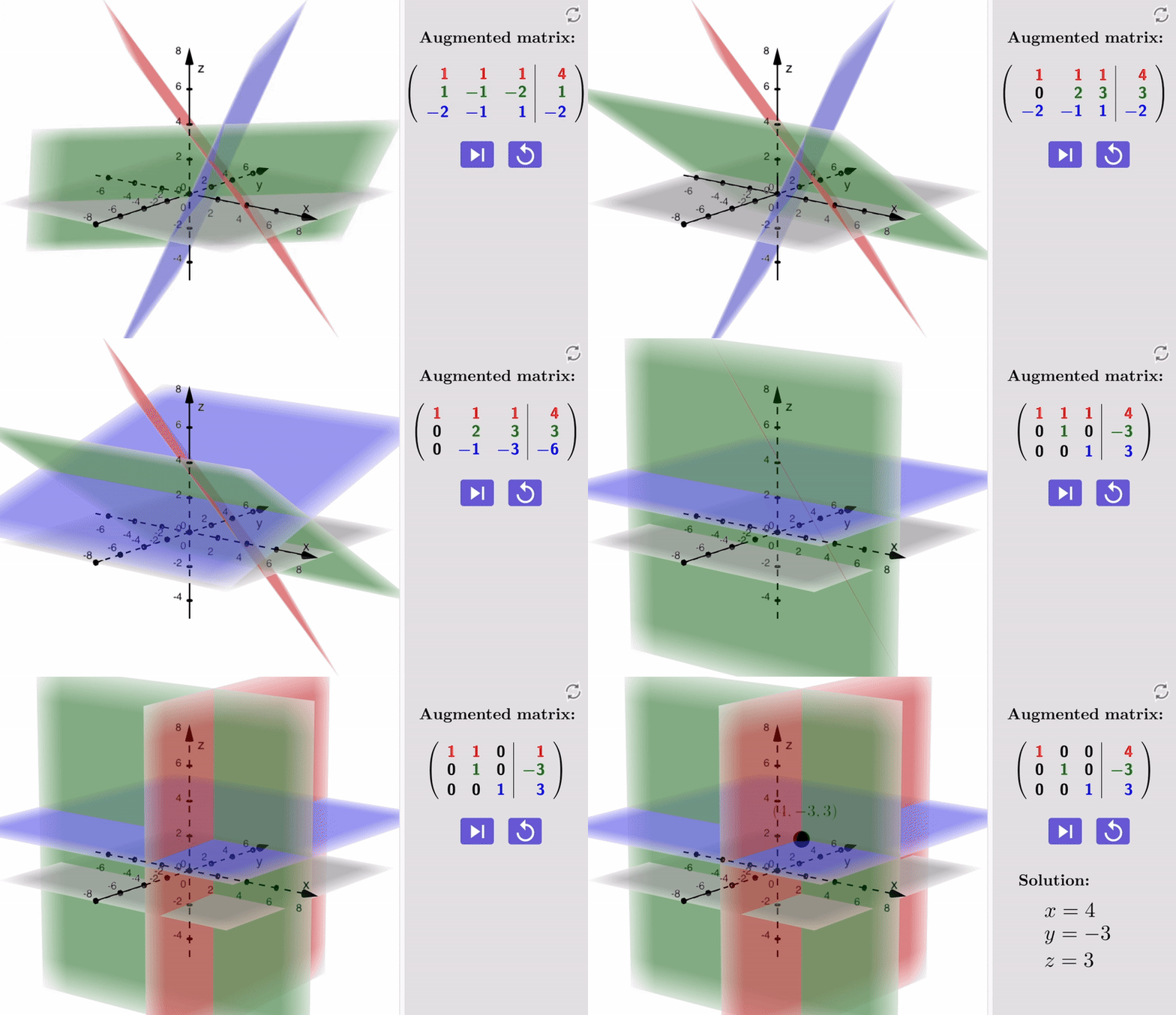
Mathematics: Solutions to linear systems.
|
\[ \begin{array}{rcl} a_{11}x_1 + a_{12}x_2 + \cdots + a_{1n}x_n &=& b_1\\ a_{21}x_1 + a_{22}x_2 + \cdots + a_{2n}x_n &=& b_2\\ \vdots && \vdots\\ a_{n1}x_1 + a_{n2}x_2 + \cdots + a_{nn}x_n &=& b_n \end{array} \] \[ \left( \begin{array}{ccc} a_{11} & \cdots & a_{1n} \\ \vdots & \ddots & \vdots \\ a_{n1} & \cdots & a_{nn} \\ \end{array} \right) \left( \begin{array}{c} x_{1} \\ \vdots \\ x_{n} \\ \end{array} \right) = \left( \begin{array}{c} b_{1} \\ \vdots\\ b_{n} \\ \end{array} \right) \] \[ \Large A \mathbf x = \mathbf b \] |
Areas and applications where Linear Algebra is needed
Statistics: Regression (lines of best fit); data approximation.
Areas and applications where Linear Algebra is needed
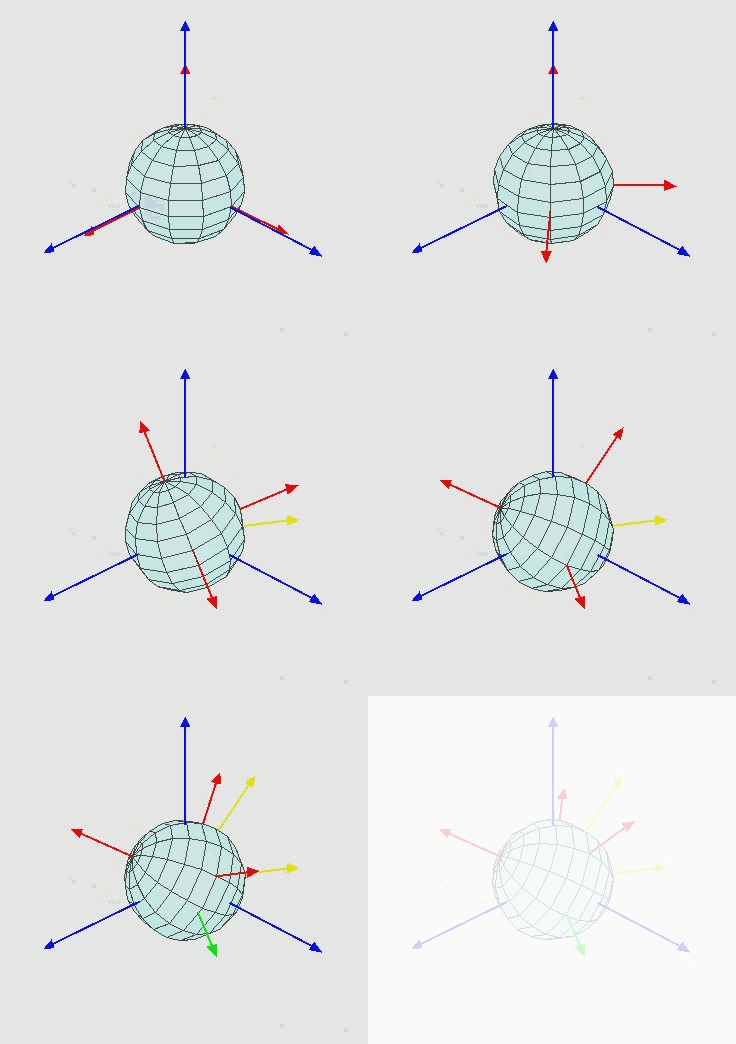
Computer Science: Computer graphics (especially games).
|
$$ {\begin{pmatrix}\cos \gamma &-\sin \gamma &0\\\sin \gamma &\cos \gamma &0\\0&0&1\\\end{pmatrix}}\qquad {\begin{pmatrix}\cos \beta &0&\sin \beta \\0&1&0\\-\sin \beta &0&\cos \beta \\\end{pmatrix}} $$ $${\begin{pmatrix}1&0&0\\0&\cos \alpha &-\sin \alpha \\0&\sin \alpha &\cos \alpha \\\end{pmatrix}}$$ |
Areas and applications where Linear Algebra is needed
Computer Science: Computer graphics (especially games).
Applications: Searching engines

Applications: Searching engines
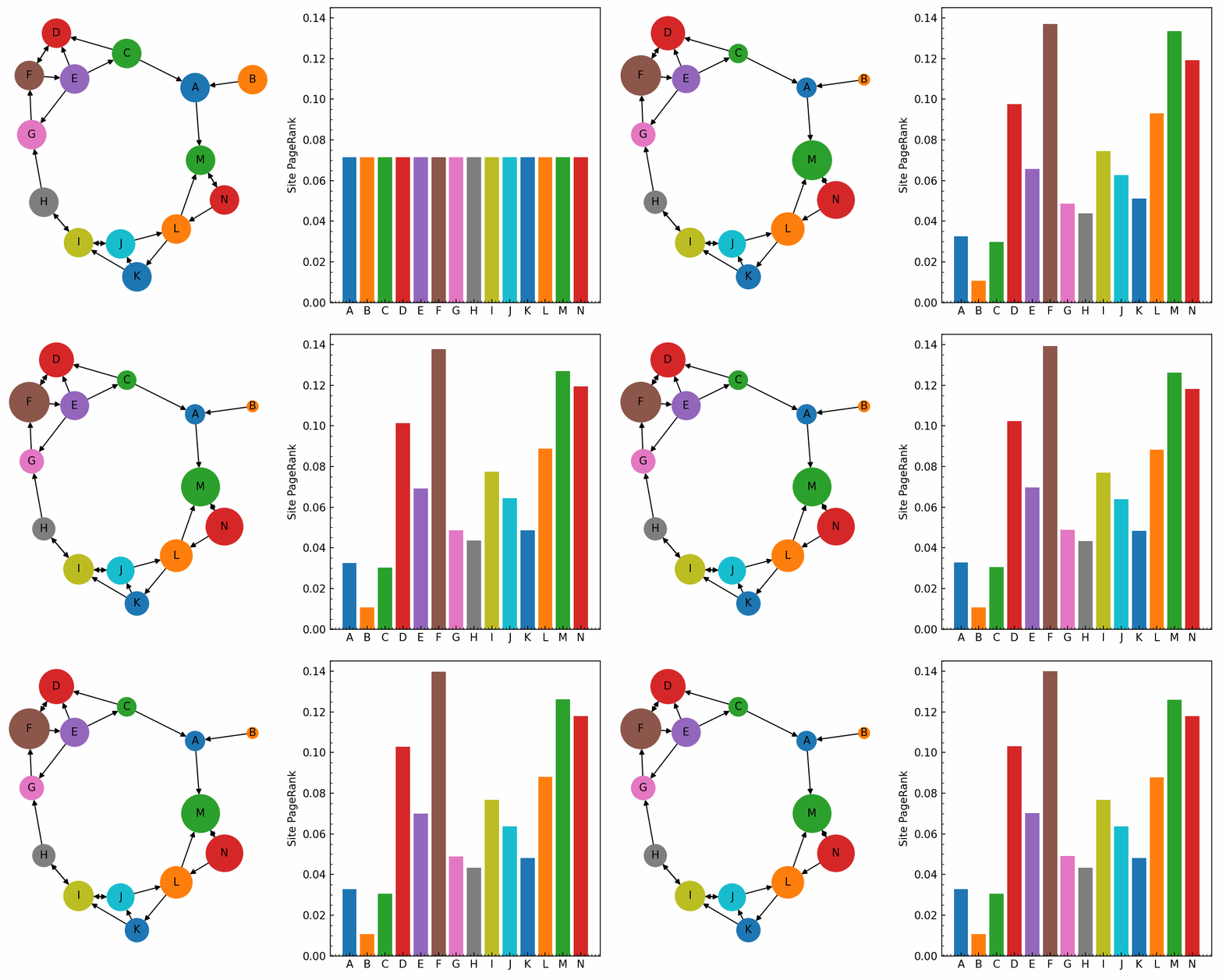
PageRank algorithm running on a small network of pages. The size of the nodes represents the perceived importance of the page, and arrows represent hyperlinks.
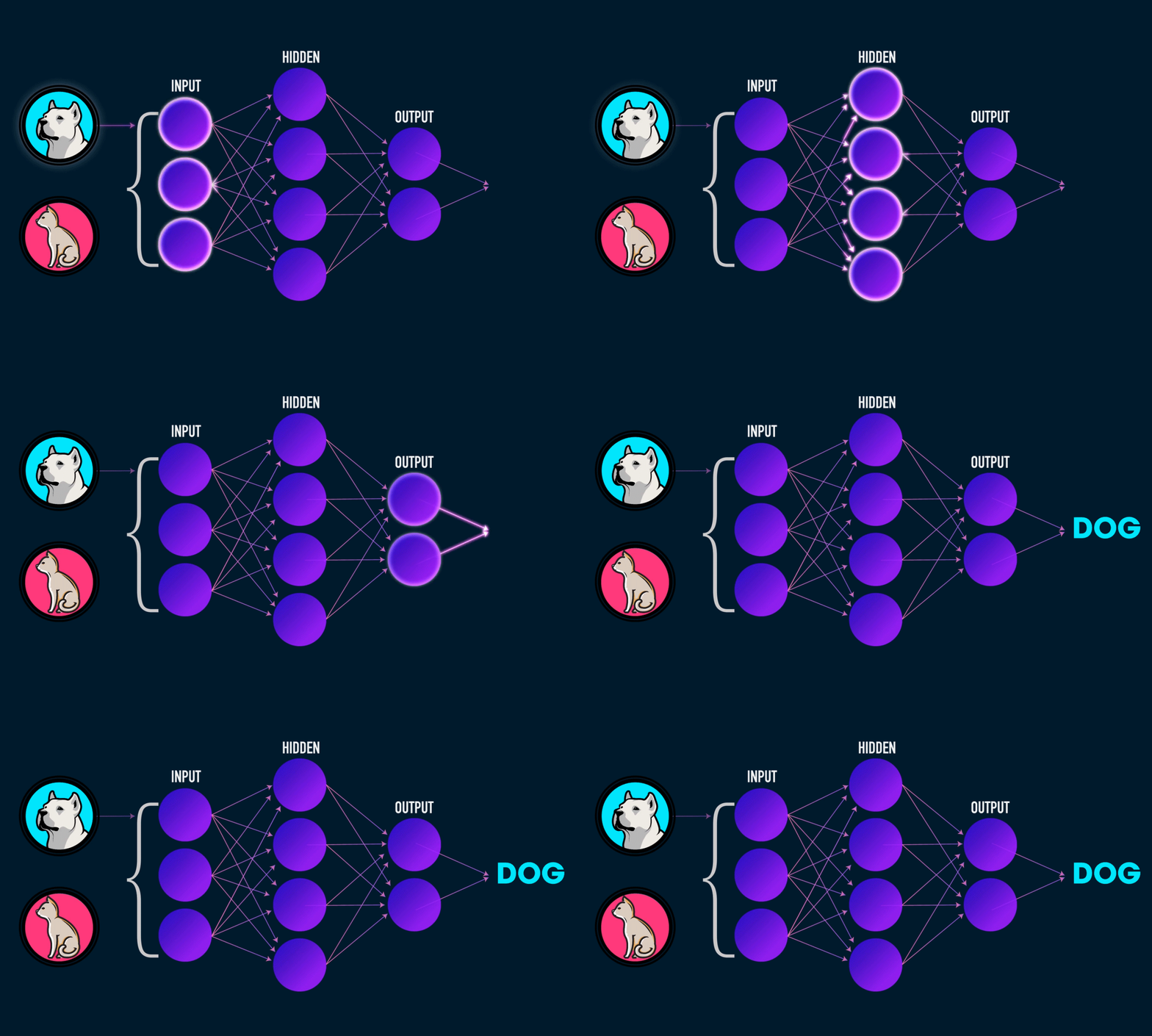
Applications: AI & Machine learning
DALL$\cdot$E (2021)
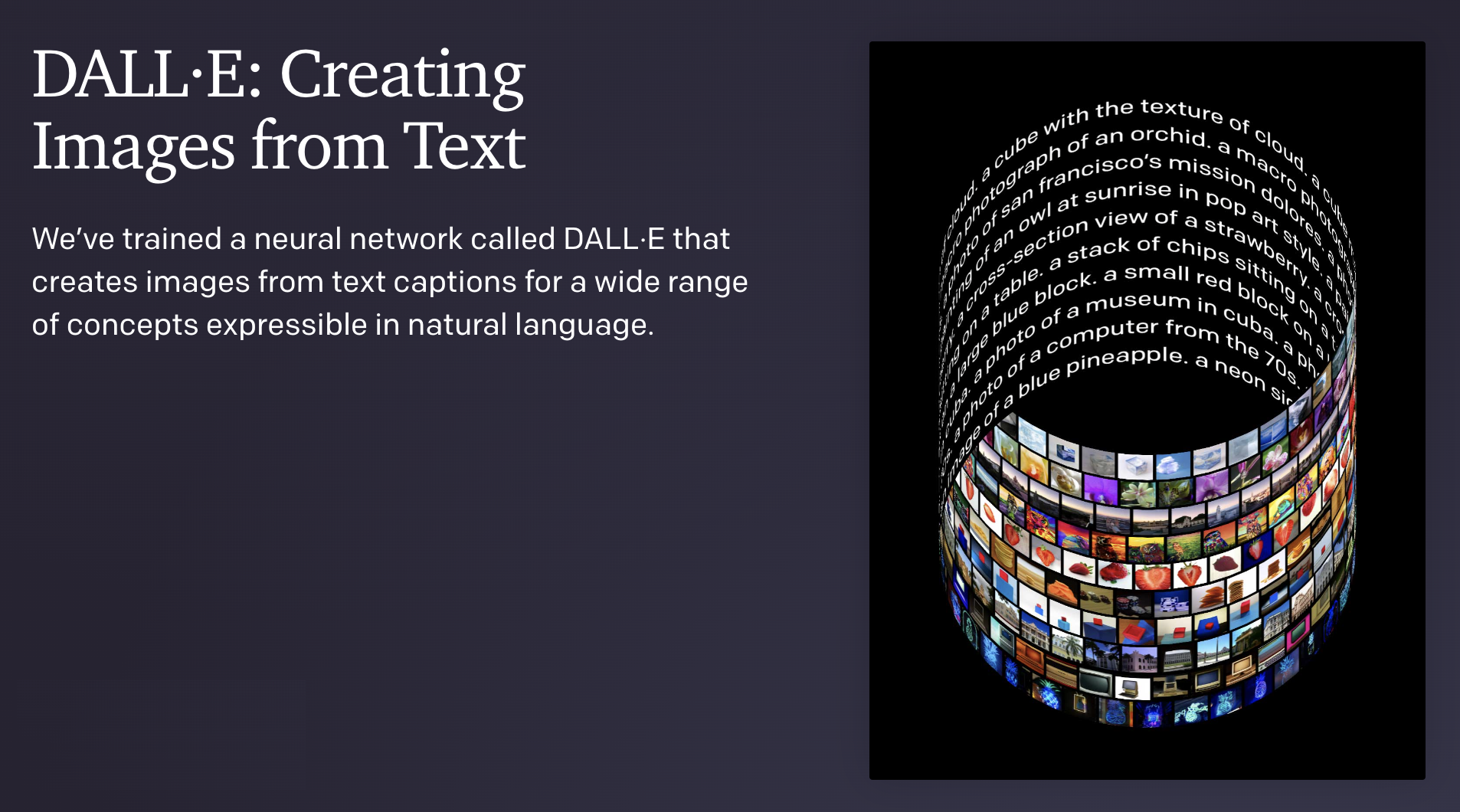
DALL$\cdot$E (2021)
More details here: Hierarchical Text-Conditional Image Generation with CLIP Latents
ChatGPT (2022)
More details here: GPT-4 Technical Report
Areas and applications where Linear Algebra is needed
- Mathematics: Solutions to linear systems; solutions to systems of ODEs; function interpolation (e.g. cubic splines); many other applications.
- Statistics: Regression (lines of best fit); data approximation; Principal Component Analysis (PCA).
- Physics: Electric circuits; optics; coupled dynamical systems; most of quantum mechanics.
- Chemistry: Balancing chemical reactions; balancing systems of chemical reactions; chemometrics.
- Engineering: Mechanical motion; stress testing.
- Computer Science: Computer graphics (especially games); coding theory; computer networking; image compression.
- Others: Global Positioning System (GPS); finance (balancing market forces); Artificial Intelligence (AI); social networks.
Why do we study Linear Algebra?
-
Linear systems have 'nice' properties that make
them easier to solve
- This helps us to solve many real-world problems...
-
Many nonlinear systems can be studied by building on linear
theories
- Linearisation of nonlinear ODEs
- Perturbation theory (= linear system + nonlinear perturbation)
-
Many mathematical problems rely on linear algebra
- Solutions of differential equations (DEs).
- Series representation of functions (e.g. Fourier theory)
Linear Algebra outline
- Systems of simultaneous linear equations
- Matrices
- Linear transformations
- Eigenvalues and eigenvectors
- Inner products
- Vector spaces
- Factorisation
- Applications
Prerequisite Knowledge
Assumed that you know
- what a matrix is;
- how to add, multiply, and transpose matrices;
- what a symmetric matrix is.
Assumed that you have seen and will quickly recall
- how to interpret matrices as transformations;
- Gaussian elimination;
- how to invert matrices;
- how to calculate determinants;
- how to find eigenvalues/vectors of 2x2 matrices.