
Complex Analysis & Applications
3203NSC
Week 2
Limit definition
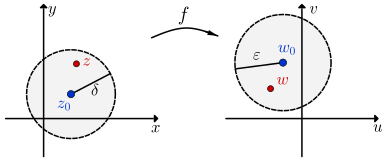
Let a function $f$ be defined at all points $z$ in some deleted neighborhood of $z_0.$ The statement that the limit of $f (z)$ as $z$ approaches $z_0$ is a number $w_0,$ or that \begin{eqnarray}\label{limit001} \lim_{z\rightarrow z_0}f(z)=w_0 \end{eqnarray} means that the point $w = f (z)$ can be made arbitrarily close to $w_0$ if we choose the point $z$ close enough to $z_0$ but distinct from it.
Formally, the expression $\lim_{z\rightarrow z_0}f(z)=w_0$ means that for every (sufficiently small) $\varepsilon>0,$ there is a $\delta>0$ such that \begin{eqnarray} \left|f (z) - w_0\right| \lt \varepsilon \quad \text{whenever}\quad 0 \lt \left|z - z_0\right| \lt \delta . \end{eqnarray}
Limit definition
Formally, the expression $\lim_{z\rightarrow z_0}f(z)=w_0$ means that for every (sufficiently small) $\varepsilon>0,$ there is a $\delta>0$ such that \begin{eqnarray} \left|f (z) - w_0\right| \lt \varepsilon \quad \text{whenever}\quad 0 \lt \left|z - z_0\right| \lt \delta . \end{eqnarray}
Example 1
Show that $\ds \lim_{z\rightarrow z_0}z^2=z_0^2.$
Discussion: Consider $\delta \leq 1.$ So $0\lt\left| z-z_0\right|\lt\delta$ implies that
$\left| z^2-z_0^2\right|$ $ =\left| z-z_0\right|\left| z+z_0\right| $ $\lt\delta \left|z+z_0\right|$ $\lt \delta \left| z-z_0+2z_0\right|$
$\lt \delta \big( \left| z-z_0\right|+2\left|z_0\right|\big) $ $ \lt \delta \big(1+2\left|z_0\right|\big).$
Now, take $\delta = 1 $ or $\delta=\dfrac{\varepsilon}{1+2\left|z_0\right|},$ whichever is smaller. Then $0\lt\left| z-z_0\right|\lt\delta$ implies that $$\left| z^2-z_0^2\right|\lt\varepsilon.$$
Example 1
Show that $\ds \lim_{z\rightarrow z_0}z^2=z_0^2.$
Proof: Let $\varepsilon>0.$ Choose $\delta=\min\left\{1,\dfrac{\varepsilon}{1+2\left|z_0\right|}\right\}$ such that $0\lt\left| z-z_0\right|\lt\delta.$ Therefore $$ \left| z^2-z_0^2\right|\lt\varepsilon. \quad \blacksquare $$
Example 2
Show that $\lim_{z\rightarrow 0}\dfrac{z}{\overline{z}}$ does not exist.
Solution:
Suppose that the limit exists. Thus we can calculate it by letting the point $z = x+iy$ approach the origin in any manner. However, when $z = x+i0$ is a nonzero point on the real axis $$f(z)=\frac{x+i0}{x-i0}=1;$$ and when $z=0+iy$ is a nonzero point on the imaginary axis, $$f(z)=\frac{0+iy}{0-iy}=-1.$$
Example 2
Show that $\lim_{z\rightarrow 0}\dfrac{z}{\overline{z}}$ does not exist.
Solution:
Thus, if we let $z$ approach the origin along the real axis, we found that the limit is $1.$ On the other hand, if we approach along the imaginary axis we found the limit $-1,$ which is a contradiction because a limit is unique. Therefore we must conclude that limit $$\lim_{z\rightarrow 0}\dfrac{z}{\overline{z}}$$ does not exist.